
Each transformation of a Ciao into an ebike at Ambra Italia follows a defined, controlled, and traced path. It is not a simple installation of components, but a structured process that involves technical checks at every stage of processing. Below is a concrete overview of what goes on behind the scenes.
A card for each vehicle
It all starts with the Work and Controls Sheet, an internal document that accompanies each vehicle from the first phase of processing to the final test. Operations are classified into three categories:
- AA: restoration work (painting, fork, wheel overhaul, sandblasting, etc.), where required;
- AB: operations related to the transformation into an e-bike (preparation of the frame, installation of the battery, structural components, wiring, driving wheel, etc.);
- C: intermediate controls, distributed throughout the process.
In all, 77 phases (14 of intermediate and final checks). Each phase is numbered, traced, and associated with precise operating instructions, to guarantee uniformity and replicability.
Battery Load Testing
Before being installed on a vehicle, each 36V - 25Ah battery is subjected to a constant load test of 350W, a power higher than the nominal power of the motor (250W), but consistent with the typical delivery peaks in the starting phase.
During the test, the following are recorded:
- the initial no-load voltage,
- the output voltage and current every 30 minutes (plus a reading after the first 2 minutes),
- the real capacity in Wh (calculated on the basis of delivery time and power),
- the residual voltage at rest 3 minutes after the end of the test.
The test stops at 33V, the threshold chosen so as not to stress the cells, even if the battery could continue to discharge. The report is delivered to the customer with the converted vehicle, complete with serial number, Ambra Italia internal ID, license plate data and graph of the discharge curve.
Engine: Vacuum and road tests
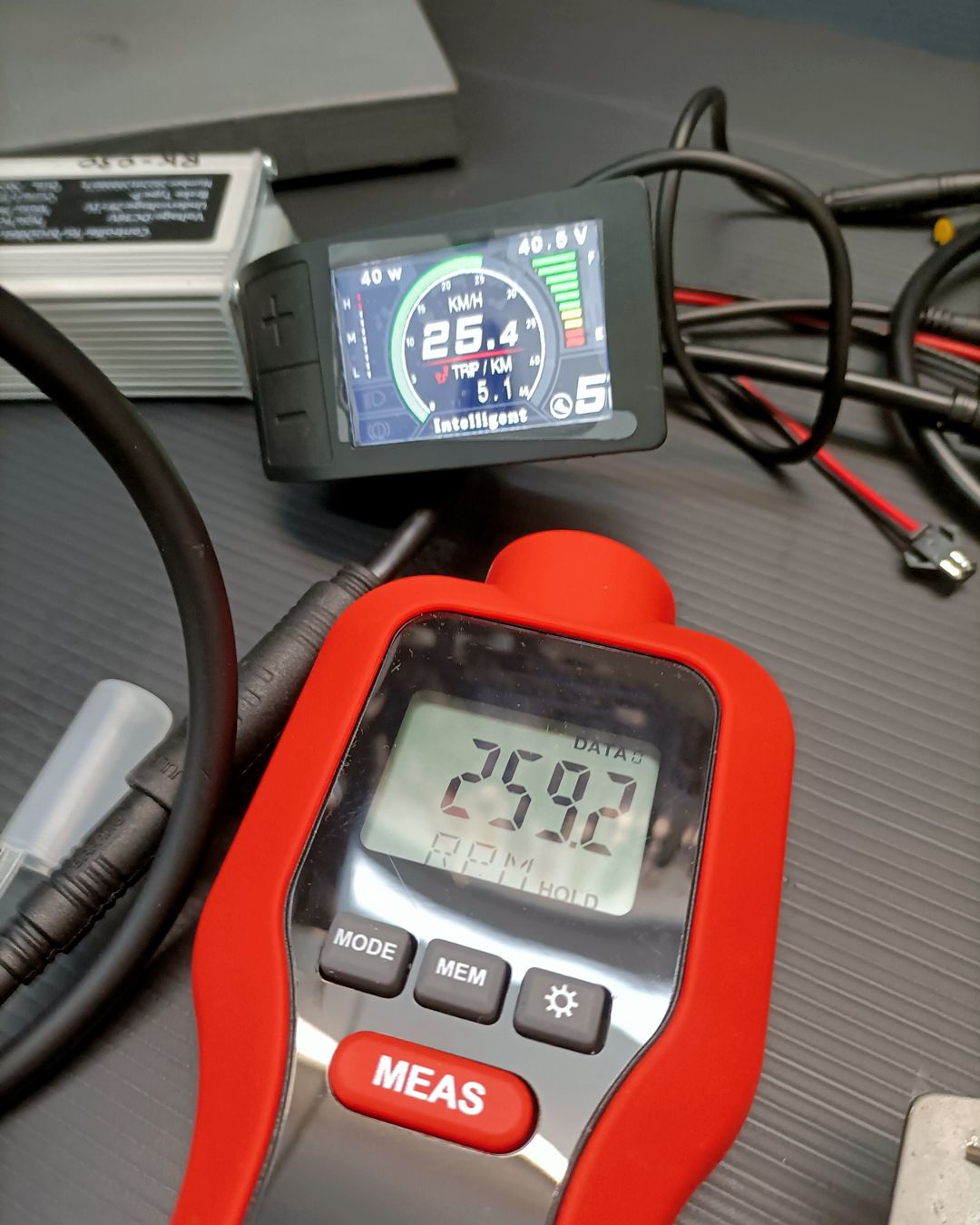
The motor is also tested before wheel mounting. The test includes all the components of the kit: controller, display, motion sensor, brake levers and electrical cables connecting components. The following are carried out:
- idle rotation tests, setting the display to two speeds: 25 km/h and maximum speed),
- measurements on all levels of assistance,
- comparison between the speed shown on the display and that detected with the laser speedometer, calculated on the revolutions per minute per wheel with a diameter equal to that of the Ciao.
After the radius and rimping, the test is repeated, to make sure that the assembly has not compromised the operation of the engine.
In the case of transformations carried out directly at the Ambra Italia headquarters, a road test is also carried out, comparing the speed indicated by the display with that measured by GPS. Also in this case, all the components used are identifiable with a unique code (e.g. RK117 for the controller), traceable throughout the processing cycle.
Final testing
The last phase, fundamental, is the final testing. A checklist consisting of thirteen items summarises the mechanical, electrical, functional, and aesthetic checks of the vehicle.
Among the checks carried out:
- tightening (frame, fork, transmission, electrical part),
- operation steering lock, battery, brakes, headlights, horn, USB socket,
- tire pressure,
- bodywork and identification stickers check,
- charger testing,
- test drive.
Behind every Ciao transformed into an ebike, there is a work system that combines precision craftsmanship and technical rigor. Everything is checked, tested, traced. Every battery, every engine, every vehicle goes through a sequence of checks that certifies its correct functioning and safety. It's not a way to appear. It's the right way to work.
- E-BIKE TRANSFORMATION
- HISTORY OF CIAO PIAGGIO
- EVENTS
- ASSEMBLY OF KITS PURCHASED ONLINE
- OUR AUTHORIZED WORKSHOPS
- MAINTENANCE OF E-BIKES AMBRA ITALIA
- ELECTRIC MICRO-MOBILITY
- SCHOOL PROJECT: INNOVATING WITH AMBRA ITALIA
- ELEGANT AND SUSTAINABLE MOBILITY FOR RECEPTION STRUCTURES
- THE WORLD THROUGH CIAO: OUR CUSTOMERS' STORIES
- RESEARCH AND INNOVATION
- BEHIND THE SCENES OF AMBRA ITALIA
- Differences between Ciao SC and PX series frames and impact on transformation
- The people of Ciao
- Ciao endothermic vs Ciao transformed into an e-bike: analysis of operating costs
- How to read and correctly interpret the Operating Instructions
- Because Ciao is beautiful
- Ciao Piaggio and women: a bond to tell
- Interview with a technician: what is it like to work on an electric Ciao?
- The Silence of the Myth – Pedal-Powered Emotions with an Electric Ciao
- Comparative Analysis of Environmental Impact: Ciao Piaggio Endothermic vs Ciao transformed into an E-Bike
- Safety First: Checking the Safety Systems on Ciao Transformed into E-Bikes
- The Longevity of E-Bikes: How Ambra Italia Extends the Life Cycle of the Ciao Piaggio
- The role of Ciao Piaggio transformed into an e-bike in the challenges of contemporary mobility
- Urban Efficiency: How the Ciao Piaggio transformed into E-Bikes by Ambra Italia revolutionize city spaces with style
- Navigating the Regulations: Current and Future Legislation on Electric Micro Mobility
- Post-Transformation Personalization: Opportunities and Limitations
- Ciao Restoration: Options and Tips
- Comparison between the efficiency of an internal combustion engine and an electric engine in mobility
- Building Long-Lasting Customer Relationships: Strategies for Workshops
- Electric rebirth: the Ciao Piaggio in the era of micro mobility
- Ciao Piaggio in cinema and pop culture
- Electricity System Integration: Challenges and Solutions
- Document Writing Philosophy: Everything Under Control
- Micro-Electric Mobility vs. Long-Distance Electric Mobility: Analysis and Perspectives
- The technology behind the myth: mechanical innovations of the Ciao Piaggio
- Compliance with Regulations: Safety and Certifications
- Steps towards Authorization: How to Become an Authorized Ambra Italia Workshop
- Cleaning and Care of your Ciao transformed into an E-Bike: Tips for Aesthetic Maintenance
- The Operating Instructions and Other Documents for the Assembly and Control of the Processes
- Micro Mobility and Social Responsibility: How Companies Can Make a Difference
- From work to free time: the Ciao Piaggio as a symbol of freedom
- The Materials Used
- From Niche to Mainstream: The Evolution of the Electric Micro Mobility Market
- Joining the Ambra Italia Network: Advantages and Opportunities for New Workshops
- Tests on Critical Components: battery and motor system
- Competing icons
- The Ciao and the urban mobility revolution
- E-Bike or electric motorbike? The choice of the type of transformation determines the approval
- The Role of Electric Micro-Mobility in Reducing Urban Pollution
- Collaborating to Innovate: The Flow of Information between Headquarters and Workshops
- Optimize the battery life of your Ambra Italia e-bike
- Quality Controls on Materials
- Design evolution
- Structural Problems
- Security and Micro Mobility. Standards and Recommended Practices for Electric Driving
- The Emoving Days 2024
- The components of the kit: panoramic
- Excellence in the service: Ambra Italia quality standards
- Basic maintenance of the Ambra Italia-Bike: step by step Guide for Newfits
- Keep the original design
- The future is here
- Birth of an icon