


In the panorama of urban mobility, few vehicles have had as profound and lasting an impact as the Ciao Piaggio. Launched in the late 1960s, this moped was not just a means of transportation; it has become a symbol of freedom, practicality and innovation. Let's examine how the Ciao has revolutionized personal transport, making it more accessible and suitable for urban life.
History and Origins:
The Ciao Piaggio was born in an era of great cultural and social ferment, perfectly interpreting the spirit and needs of youth for freedom. With its simple, reliable design and ease of use, it offered a practical and economical solution to urban mobility problems, ushering in a new era for personal transport in Italian cities and beyond.
Impact on Urban Mobility and the Role of Advertising Campaigns:
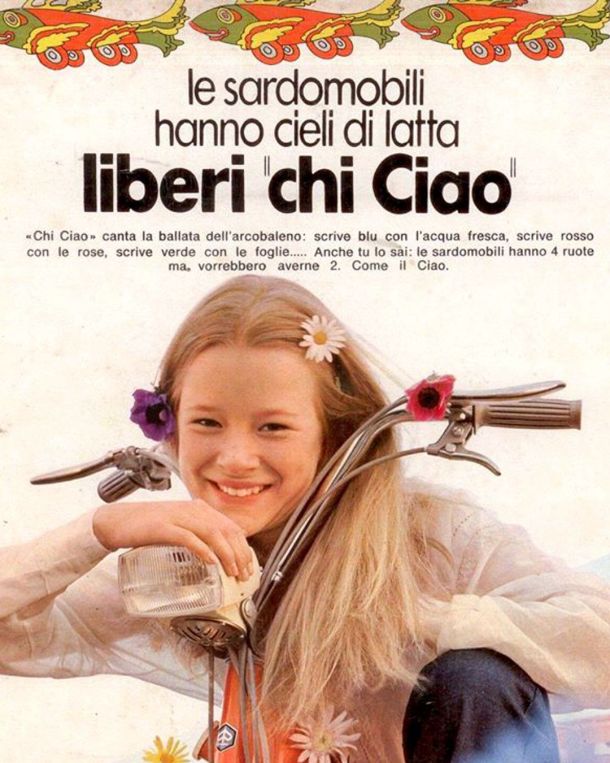
The Ciao Piaggio not only revolutionized the concept of urban mobility with its lightness, easy handling and affordable cost, but was also the subject of innovative advertising campaigns that underlined its transformative role in society. One of the most memorable, at the beginning of the 1970s, proposed the Ciao as a practical and stylish alternative to the "sardomobili" (mobile sardines), a joking term used to describe the small overcrowded cars typical of the time, a symbol of urban mobility still linked to traditional concepts and not sustainable.
This advertising campaign struck the collective imagination, emphasizing the freedom, independence and flexibility that the Ciao offered compared to cars. With its incisive message and a young and dynamic image, the campaign managed to capture the attention of a large audience, promoting the moped not only as a means of transport but as an expression of a modern and environmentally conscious lifestyle.
The advertising strategies adopted by Piaggio played a crucial role in making the Ciao the symbol of a new era for urban mobility. Through catchy slogans and images that reflected users' aspirations for freedom and autonomy, these campaigns effectively communicated the added value of Ciao in terms of convenience and accessibility. In a period in which the car still represented a luxury for many, the Ciao was proposed as the ideal solution for those who wanted to move with agility and independence in increasingly congested cities.
By democratizing individual mobility, Ciao offered a large segment of the population the opportunity to embrace a new way of experiencing urbanity, profoundly influencing habits and perceptions of personal transport. These advertising campaigns not only contributed to the Ciao's commercial success but cemented its place in popular culture as an icon of an era of change, underlining its lasting impact on society.
Changes in Consumer Tastes and Innovations:
Over the years, Ciao Piaggio has been able to adapt to changes in consumer tastes and technological evolutions. From the first versions to the most recent ones, it has incorporated mechanical improvements and aesthetic changes that have maintained its appeal. Despite the innovations, the Ciao has always maintained its essence: a practical, economical means of transport characterized by an unmistakable design.
The Role in the Current Context:
Today, with increased awareness towards issues such as sustainability and reducing pollution, the Ciao Piaggio continues to be relevant, especially in its more modern iterations that explore electric propulsion. The transformation of those still existing into e-bikes, carried out by Ambra Italia, represents a bridge between past and future, offering a mobility solution that respects the environment without sacrificing style and practicality.
The Ciao Piaggio is not just a piece of Italian design history; it is an icon that has helped shape urban mobility, making it more accessible and pleasant. It continues to influence urban culture, proving that intelligent design and practicality never go out of style. As we look to the future of urban mobility, Ciao remains a point of reference and inspiration, an example of how tradition can meet innovation to address contemporary challenges.
Images: Piaggio & C. S.p.A archive
- E-BIKE TRANSFORMATION
- HISTORY OF CIAO PIAGGIO
- EVENTS
- ASSEMBLY OF KITS PURCHASED ONLINE
- OUR AUTHORIZED WORKSHOPS
- MAINTENANCE OF E-BIKES AMBRA ITALIA
- ELECTRIC MICRO-MOBILITY
- SCHOOL PROJECT: INNOVATING WITH AMBRA ITALIA
- ELEGANT AND SUSTAINABLE MOBILITY FOR RECEPTION STRUCTURES
- THE WORLD THROUGH CIAO: OUR CUSTOMERS' STORIES
- RESEARCH AND INNOVATION
- BEHIND THE SCENES OF AMBRA ITALIA
- Smart cities and vintage mobility: why the future may have roots in the past
- Differences between Ciao SC and PX series frames and impact on transformation
- The people of Ciao
- Ciao endothermic vs Ciao transformed into an e-bike: analysis of operating costs
- How to read and correctly interpret the Operating Instructions
- Because Ciao is beautiful
- Ciao Piaggio and women: a bond to tell
- Interview with a technician: what is it like to work on an electric Ciao?
- The Silence of the Myth – Pedal-Powered Emotions with an Electric Ciao
- Comparative Analysis of Environmental Impact: Ciao Piaggio Endothermic vs Ciao transformed into an E-Bike
- Safety First: Checking the Safety Systems on Ciao Transformed into E-Bikes
- The Longevity of E-Bikes: How Ambra Italia Extends the Life Cycle of the Ciao Piaggio
- The role of Ciao Piaggio transformed into an e-bike in the challenges of contemporary mobility
- Urban Efficiency: How the Ciao Piaggio transformed into E-Bikes by Ambra Italia revolutionize city spaces with style
- Navigating the Regulations: Current and Future Legislation on Electric Micro Mobility
- Post-Transformation Personalization: Opportunities and Limitations
- Ciao Restoration: Options and Tips
- Comparison between the efficiency of an internal combustion engine and an electric engine in mobility
- Building Long-Lasting Customer Relationships: Strategies for Workshops
- Electric rebirth: the Ciao Piaggio in the era of micro mobility
- Ciao Piaggio in cinema and pop culture
- Electricity System Integration: Challenges and Solutions
- Document Writing Philosophy: Everything Under Control
- Micro-Electric Mobility vs. Long-Distance Electric Mobility: Analysis and Perspectives
- The technology behind the myth: mechanical innovations of the Ciao Piaggio
- Compliance with Regulations: Safety and Certifications
- Steps towards Authorization: How to Become an Authorized Ambra Italia Workshop
- Cleaning and Care of your Ciao transformed into an E-Bike: Tips for Aesthetic Maintenance
- The Operating Instructions and Other Documents for the Assembly and Control of the Processes
- Micro Mobility and Social Responsibility: How Companies Can Make a Difference
- From work to free time: the Ciao Piaggio as a symbol of freedom
- The Materials Used
- From Niche to Mainstream: The Evolution of the Electric Micro Mobility Market
- Joining the Ambra Italia Network: Advantages and Opportunities for New Workshops
- Tests on Critical Components: battery and motor system
- Competing icons
- The Ciao and the urban mobility revolution
- E-Bike or electric motorbike? The choice of the type of transformation determines the approval
- The Role of Electric Micro-Mobility in Reducing Urban Pollution
- Collaborating to Innovate: The Flow of Information between Headquarters and Workshops
- Optimize the battery life of your Ambra Italia e-bike
- Quality Controls on Materials
- Design evolution
- Structural Problems
- Security and Micro Mobility. Standards and Recommended Practices for Electric Driving
- The Emoving Days 2024
- The components of the kit: panoramic
- Excellence in the service: Ambra Italia quality standards
- Basic maintenance of the Ambra Italia-Bike: step by step Guide for Newfits
- Keep the original design
- The future is here
- Birth of an icon