


The Piaggio Ciao, an icon of Italian mobility, has spanned generations while keeping its charm and usefulness intact. Born in the 60s, this moped represented a revolution in urban mobility, offering a simple, economical, and accessible means of transport for all. Today, despite the advent of modern technologies and new forms of mobility, the Ciao Piaggio continues to be a symbol of innovation and adaptability. This article explores how the Ciao Piaggio, with its historical legacy, can still offer valuable lessons on the current challenges of urban and sustainable mobility.
The birth of the Ciao Piaggio: an innovation for the time
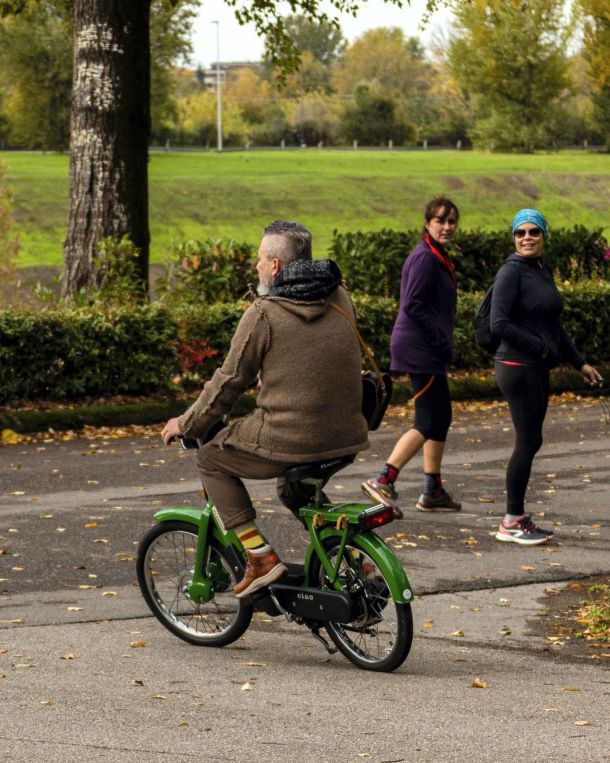
When the Ciao Piaggio was launched in 1967, the world was changing rapidly. Cities were growing, traffic was increasing, and the need for convenient and accessible means of transportation was evident. The Ciao responded to this need with a minimalist design, a reliable two-stroke engine, and an affordable price. Its mechanical simplicity and ease of maintenance made it immediately popular, becoming the preferred vehicle of students, workers, and families.
Sustainability lessons from the past
At a time when sustainability has become a global priority, the Ciao Piaggio reminds us of the importance of simplicity and durability. Its robust construction and streamlined design meant fewer components prone to wear and tear, thus reducing the need for frequent replacements. This approach contrasts with the mindset of today's consumerism, where short-lived products contribute to a growing waste problem. The Ciao, with its longevity, teaches us that true sustainability is based on durability and efficiency.
Adaptability and innovation
Another key aspect of the Ciao Piaggio is its adaptability. Although designed over half a century ago, the Ciao has proven that it can be updated and transformed to meet modern needs. Ambra Italia has taken advantage of this feature, transforming, with its own kit, the old Ciao into modern e-bikes. This transformation not only extends the life of the Ciao, but also makes it relevant in today's cities, where electric mobility is increasingly necessary to reduce pollution and improve the quality of urban life.
Ciao Piaggio and contemporary urban mobility
Modern cities face significant challenges in terms of traffic congestion, air pollution, and climate change. The Ciao Piaggio, with its simplicity and efficiency, represents a solution to these challenges. E-bikes derived from the Ciao offer sustainable urban mobility, reducing dependence on motor vehicles and contributing to a decrease in CO2 emissions and, also considering the non-existent cost for its management, making it accessible to a wide range of users-
Cultural value and identity
In addition to its practical aspects, the Ciao Piaggio holds significant cultural value. It is a symbol of Italian ingenuity, artisanry and innovation. For many people, the Ciao represents childhood memories, youthful adventures, and a sense of freedom. Keeping this symbol alive through the transformation into an e-bike not only preserves the cultural heritage, but adapts it to contemporary needs, creating a bridge between past and future.
The Ciao Piaggio, despite its age, continues to be a valuable lesson for the challenges of contemporary mobility. Its simplicity, durability and adaptability offer important lessons on how to approach urban and sustainable mobility. Ambra Italia, through the transformation of the old Ciaos into modern e-bikes, proves that it is possible to honor the past while looking to the future, creating mobility solutions that are both innovative and environmentally friendly. We invite everyone to rediscover the Ciao Piaggio not only as a vehicle of the past, but as a symbol of how mobility can and must evolve.
- E-BIKE TRANSFORMATION
- HISTORY OF CIAO PIAGGIO
- EVENTS
- ASSEMBLY OF KITS PURCHASED ONLINE
- OUR AUTHORIZED WORKSHOPS
- MAINTENANCE OF E-BIKES AMBRA ITALIA
- ELECTRIC MICRO-MOBILITY
- SCHOOL PROJECT: INNOVATING WITH AMBRA ITALIA
- ELEGANT AND SUSTAINABLE MOBILITY FOR RECEPTION STRUCTURES
- THE WORLD THROUGH CIAO: OUR CUSTOMERS' STORIES
- RESEARCH AND INNOVATION
- BEHIND THE SCENES OF AMBRA ITALIA
- Smart cities and vintage mobility: why the future may have roots in the past
- Differences between Ciao SC and PX series frames and impact on transformation
- The people of Ciao
- Ciao endothermic vs Ciao transformed into an e-bike: analysis of operating costs
- How to read and correctly interpret the Operating Instructions
- Because Ciao is beautiful
- Ciao Piaggio and women: a bond to tell
- Interview with a technician: what is it like to work on an electric Ciao?
- The Silence of the Myth – Pedal-Powered Emotions with an Electric Ciao
- Comparative Analysis of Environmental Impact: Ciao Piaggio Endothermic vs Ciao transformed into an E-Bike
- Safety First: Checking the Safety Systems on Ciao Transformed into E-Bikes
- The Longevity of E-Bikes: How Ambra Italia Extends the Life Cycle of the Ciao Piaggio
- The role of Ciao Piaggio transformed into an e-bike in the challenges of contemporary mobility
- Urban Efficiency: How the Ciao Piaggio transformed into E-Bikes by Ambra Italia revolutionize city spaces with style
- Navigating the Regulations: Current and Future Legislation on Electric Micro Mobility
- Post-Transformation Personalization: Opportunities and Limitations
- Ciao Restoration: Options and Tips
- Comparison between the efficiency of an internal combustion engine and an electric engine in mobility
- Building Long-Lasting Customer Relationships: Strategies for Workshops
- Electric rebirth: the Ciao Piaggio in the era of micro mobility
- Ciao Piaggio in cinema and pop culture
- Electricity System Integration: Challenges and Solutions
- Document Writing Philosophy: Everything Under Control
- Micro-Electric Mobility vs. Long-Distance Electric Mobility: Analysis and Perspectives
- The technology behind the myth: mechanical innovations of the Ciao Piaggio
- Compliance with Regulations: Safety and Certifications
- Steps towards Authorization: How to Become an Authorized Ambra Italia Workshop
- Cleaning and Care of your Ciao transformed into an E-Bike: Tips for Aesthetic Maintenance
- The Operating Instructions and Other Documents for the Assembly and Control of the Processes
- Micro Mobility and Social Responsibility: How Companies Can Make a Difference
- From work to free time: the Ciao Piaggio as a symbol of freedom
- The Materials Used
- From Niche to Mainstream: The Evolution of the Electric Micro Mobility Market
- Joining the Ambra Italia Network: Advantages and Opportunities for New Workshops
- Tests on Critical Components: battery and motor system
- Competing icons
- The Ciao and the urban mobility revolution
- E-Bike or electric motorbike? The choice of the type of transformation determines the approval
- The Role of Electric Micro-Mobility in Reducing Urban Pollution
- Collaborating to Innovate: The Flow of Information between Headquarters and Workshops
- Optimize the battery life of your Ambra Italia e-bike
- Quality Controls on Materials
- Design evolution
- Structural Problems
- Security and Micro Mobility. Standards and Recommended Practices for Electric Driving
- The Emoving Days 2024
- The components of the kit: panoramic
- Excellence in the service: Ambra Italia quality standards
- Basic maintenance of the Ambra Italia-Bike: step by step Guide for Newfits
- Keep the original design
- The future is here
- Birth of an icon