


The cities of the future are often imagined as perfectly optimized spaces.
Intelligent networks, connected infrastructures, fluid and digital mobility.
An ecosystem where every element is designed to be efficient, fast, predictable.
So-called smart cities represent this vision:
a city that thinks, adapts, optimizes.
And yet, within this highly technological scenario, an unexpected question emerges.
Is there still room for what comes from the past?
The paradox of the smart city
The smart city is, by definition, future-oriented.
It reduces waste, improves flows, integrates advanced technologies to make urban life more sustainable and efficient.
But this very pursuit of optimization can, in some cases, produce a side effect.
Homogenization.
Streets, vehicles, objects and even experiences tend to become increasingly similar, regardless of geographical or cultural context.
The city works better.
But it risks losing its identity.
The value of forms that endure
There are objects that are not merely tools.
They are expressions of a way of living.
Forms born in a specific historical context, yet capable of crossing time without losing meaning.
Not because they are immutable, but because they are built upon a deep balance between function, simplicity and design intuition.
These objects do not belong only to the past.
They belong to culture.
And for this reason, they can engage in dialogue with the present.
Vintage does not mean obsolete
Associating vintage with obsolescence is one of the most common mistakes.
In reality, many solutions from the past represent highly efficient forms of design, developed in a time when resources were limited and simplicity was a necessity.
Lightweight structures, essential mechanics, ease of maintenance.
Elements that, paradoxically, are becoming central once again today.
In the context of urban mobility, this translates into vehicles that are agile, intuitive and accessible.
Perfectly aligned with the needs of contemporary cities.
Technology and memory: a false opposition
The idea that innovation and tradition are in conflict is often an oversimplification.
Technology does not necessarily erase what already exists.
On the contrary, it can integrate with it.
And when this happens in the right way, the result is not a superposition, but a synthesis.
An object that retains its identity while acquiring new functionalities.
That preserves its language, yet speaks to the present.
In mobility, this means rethinking historical vehicles in light of contemporary technologies, without distorting their essence.
A more human mobility
Smart cities aim for efficiency.
But a city is not just a system to be optimized.
It is a lived space.
Introducing elements that carry cultural, emotional and recognizable value means restoring to mobility a dimension that is often overlooked.
The human one.
A vehicle is not merely a means of transport.
It is an experience.
And in some cases, it is also a story.
The role of micro-mobility
Within this balance between innovation and identity, micro-mobility plays a central role.
By its very nature, it is:
- flexible
- adaptable
- integrable into the urban fabric
And it is precisely at this reduced scale that new syntheses become possible.
No longer just vehicles designed to be efficient, but also to be recognizable, coherent and meaningful.
A bridge between eras
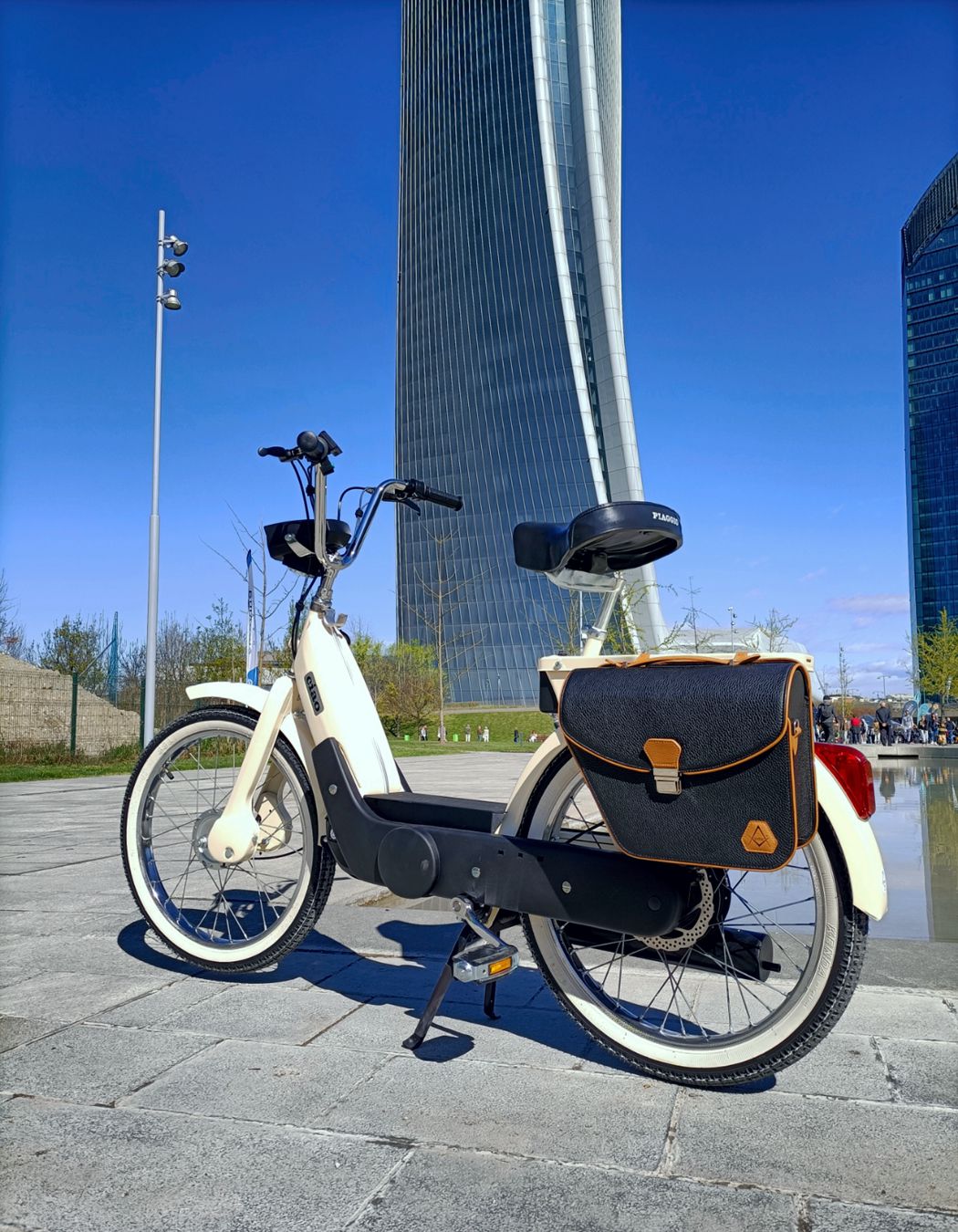
Thinking about vintage mobility within a smart city does not mean looking backward.
It means building a bridge.
A bridge between eras, between languages, between different visions of the city.
On one side, technological innovation.
On the other, design memory.
In between, a concrete possibility.
The city of the future will not be defined by technology alone.
It will be defined by choices.
By the ability to integrate what is new with what has proven to work over time.
In this scenario, vintage mobility is not out of place.
On the contrary, it can become a resource.
Because the future is not necessarily a rupture.
Sometimes, it is an evolved continuity.
- E-BIKE TRANSFORMATION
- HISTORY OF CIAO PIAGGIO
- EVENTS
- ASSEMBLY OF KITS PURCHASED ONLINE
- OUR AUTHORIZED WORKSHOPS
- MAINTENANCE OF E-BIKES AMBRA ITALIA
- ELECTRIC MICRO-MOBILITY
- SCHOOL PROJECT: INNOVATING WITH AMBRA ITALIA
- ELEGANT AND SUSTAINABLE MOBILITY FOR RECEPTION STRUCTURES
- THE WORLD THROUGH CIAO: OUR CUSTOMERS' STORIES
- RESEARCH AND INNOVATION
- BEHIND THE SCENES OF AMBRA ITALIA
- Smart cities and vintage mobility: why the future may have roots in the past
- Differences between Ciao SC and PX series frames and impact on transformation
- The people of Ciao
- Ciao endothermic vs Ciao transformed into an e-bike: analysis of operating costs
- How to read and correctly interpret the Operating Instructions
- Because Ciao is beautiful
- Ciao Piaggio and women: a bond to tell
- Interview with a technician: what is it like to work on an electric Ciao?
- The Silence of the Myth – Pedal-Powered Emotions with an Electric Ciao
- Comparative Analysis of Environmental Impact: Ciao Piaggio Endothermic vs Ciao transformed into an E-Bike
- Safety First: Checking the Safety Systems on Ciao Transformed into E-Bikes
- The Longevity of E-Bikes: How Ambra Italia Extends the Life Cycle of the Ciao Piaggio
- The role of Ciao Piaggio transformed into an e-bike in the challenges of contemporary mobility
- Urban Efficiency: How the Ciao Piaggio transformed into E-Bikes by Ambra Italia revolutionize city spaces with style
- Navigating the Regulations: Current and Future Legislation on Electric Micro Mobility
- Post-Transformation Personalization: Opportunities and Limitations
- Ciao Restoration: Options and Tips
- Comparison between the efficiency of an internal combustion engine and an electric engine in mobility
- Building Long-Lasting Customer Relationships: Strategies for Workshops
- Electric rebirth: the Ciao Piaggio in the era of micro mobility
- Ciao Piaggio in cinema and pop culture
- Electricity System Integration: Challenges and Solutions
- Document Writing Philosophy: Everything Under Control
- Micro-Electric Mobility vs. Long-Distance Electric Mobility: Analysis and Perspectives
- The technology behind the myth: mechanical innovations of the Ciao Piaggio
- Compliance with Regulations: Safety and Certifications
- Steps towards Authorization: How to Become an Authorized Ambra Italia Workshop
- Cleaning and Care of your Ciao transformed into an E-Bike: Tips for Aesthetic Maintenance
- The Operating Instructions and Other Documents for the Assembly and Control of the Processes
- Micro Mobility and Social Responsibility: How Companies Can Make a Difference
- From work to free time: the Ciao Piaggio as a symbol of freedom
- The Materials Used
- From Niche to Mainstream: The Evolution of the Electric Micro Mobility Market
- Joining the Ambra Italia Network: Advantages and Opportunities for New Workshops
- Tests on Critical Components: battery and motor system
- Competing icons
- The Ciao and the urban mobility revolution
- E-Bike or electric motorbike? The choice of the type of transformation determines the approval
- The Role of Electric Micro-Mobility in Reducing Urban Pollution
- Collaborating to Innovate: The Flow of Information between Headquarters and Workshops
- Optimize the battery life of your Ambra Italia e-bike
- Quality Controls on Materials
- Design evolution
- Structural Problems
- Security and Micro Mobility. Standards and Recommended Practices for Electric Driving
- The Emoving Days 2024
- The components of the kit: panoramic
- Excellence in the service: Ambra Italia quality standards
- Basic maintenance of the Ambra Italia-Bike: step by step Guide for Newfits
- Keep the original design
- The future is here
- Birth of an icon