
Stories, rituals, and identities of a community without borders
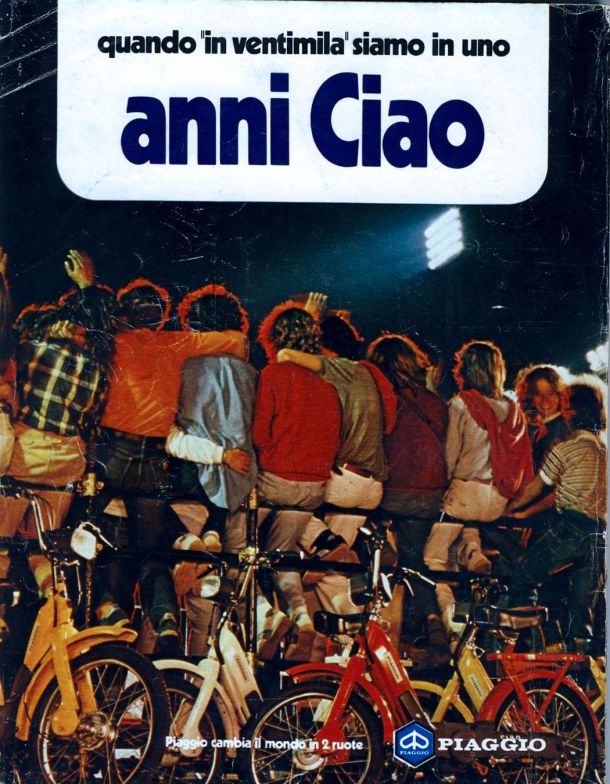
There is a people that has never had a flag, nor a seat, nor a statute. It has never given itself an official name and has never claimed to exist. Yet, for decades, it has crossed the whole of Italy, from provincial roads to the suburbs of large cities, from the coasts to inland towns.
They are the people of Ciao.
A silent and widespread community, born without programs and without posters, made up of millions of people who, without knowing it, shared the same gestures, the same places, the same emotions. A people born not from an ideology, but from a simple, accessible, everyday object: a moped.
The Ciao did not belong to a precise social category. It was not the medium of the rich, nor that of the rebels, nor that of sportsmen. It was everyone's vehicle. Of the student who crossed the village to go to school, of the worker who parked it in front of the factory, of the boy who took to the streets in the evening, of the girl who used it to go to work or to the beach.
He was seen in front of bars, outside schools, near stations, leaning against the walls of houses. In Milan as in Calabria, in Emilia as in Sicily. It cost the right amount, consumed little, was repaired everywhere. It was a gateway to mobility, not a symbol of distinction.
And it is precisely this democratic nature that has created a transversal community, without barriers and without hierarchies.
Those who were part of the Ciao people, often, did not even know it. There were no cards, no official clubs, no organized gatherings. And yet, we recognized each other. From the way of parking in front of the Sport bar, from the helmet hanging from the handlebars, from the small changes to the engine, from the unmistakable noise that came from afar.
There were informal places that became meeting points: the central square, the gas station, the courtyard of the building, the village workshop. And there were recurring times: early in the morning, in the afternoon after school, on summer evenings when the air was still warm and we stayed out late.
It was an invisible tribe, without symbols, but with shared habits.
For many, the first real workshop was not a technical school, but a garage, a cellar, a shed in the courtyard. There you learned how to disassemble a carburetor, change a spark plug, adjust a screw. Often together with a father, an older brother, a more experienced friend.
The Ciao taught that things can be understood, repaired, improved. It was a training ground for autonomy, a practical school of responsibility.
The people of Ciao had no detailed manuals or tutorials. He had stories. "Try this." "Watch out for that." "Better change that too." Knowledge passed from mouth to mouth, from hand to hand, from generation to generation. It was an imperfect, empirical, profoundly human knowledge. But it worked. And it was part of the group's identity.
For many boys and girls, the Ciao was the first real personal space. You were no longer just children, students, or apprentices. We were on the move. You could go, choose, move away, return. It was a small freedom, but fundamental. And those who lived it still carry it inside.
Today, that people has not disappeared. He has transformed. It lives on in restorers, collectors, rallies, forums, workshops, projects that choose not to let an object die, but to reinterpret it with respect. Not out of nostalgia, but for continuity.
The people of Ciao have never made noise. He never demanded attention. He never asked for recognition. He simply lived, accompanying Italy in its change, linking millions of personal stories to a collective history.
Because it is not made of metal.
It's made up of people.
And that's why it doesn't disappear.
Photo: Pinterest
- E-BIKE TRANSFORMATION
- HISTORY OF CIAO PIAGGIO
- EVENTS
- ASSEMBLY OF KITS PURCHASED ONLINE
- OUR AUTHORIZED WORKSHOPS
- MAINTENANCE OF E-BIKES AMBRA ITALIA
- ELECTRIC MICRO-MOBILITY
- SCHOOL PROJECT: INNOVATING WITH AMBRA ITALIA
- ELEGANT AND SUSTAINABLE MOBILITY FOR RECEPTION STRUCTURES
- THE WORLD THROUGH CIAO: OUR CUSTOMERS' STORIES
- RESEARCH AND INNOVATION
- BEHIND THE SCENES OF AMBRA ITALIA
- Differences between Ciao SC and PX series frames and impact on transformation
- The people of Ciao
- Ciao endothermic vs Ciao transformed into an e-bike: analysis of operating costs
- How to read and correctly interpret the Operating Instructions
- Because Ciao is beautiful
- Ciao Piaggio and women: a bond to tell
- Interview with a technician: what is it like to work on an electric Ciao?
- The Silence of the Myth – Pedal-Powered Emotions with an Electric Ciao
- Comparative Analysis of Environmental Impact: Ciao Piaggio Endothermic vs Ciao transformed into an E-Bike
- Safety First: Checking the Safety Systems on Ciao Transformed into E-Bikes
- The Longevity of E-Bikes: How Ambra Italia Extends the Life Cycle of the Ciao Piaggio
- The role of Ciao Piaggio transformed into an e-bike in the challenges of contemporary mobility
- Urban Efficiency: How the Ciao Piaggio transformed into E-Bikes by Ambra Italia revolutionize city spaces with style
- Navigating the Regulations: Current and Future Legislation on Electric Micro Mobility
- Post-Transformation Personalization: Opportunities and Limitations
- Ciao Restoration: Options and Tips
- Comparison between the efficiency of an internal combustion engine and an electric engine in mobility
- Building Long-Lasting Customer Relationships: Strategies for Workshops
- Electric rebirth: the Ciao Piaggio in the era of micro mobility
- Ciao Piaggio in cinema and pop culture
- Electricity System Integration: Challenges and Solutions
- Document Writing Philosophy: Everything Under Control
- Micro-Electric Mobility vs. Long-Distance Electric Mobility: Analysis and Perspectives
- The technology behind the myth: mechanical innovations of the Ciao Piaggio
- Compliance with Regulations: Safety and Certifications
- Steps towards Authorization: How to Become an Authorized Ambra Italia Workshop
- Cleaning and Care of your Ciao transformed into an E-Bike: Tips for Aesthetic Maintenance
- The Operating Instructions and Other Documents for the Assembly and Control of the Processes
- Micro Mobility and Social Responsibility: How Companies Can Make a Difference
- From work to free time: the Ciao Piaggio as a symbol of freedom
- The Materials Used
- From Niche to Mainstream: The Evolution of the Electric Micro Mobility Market
- Joining the Ambra Italia Network: Advantages and Opportunities for New Workshops
- Tests on Critical Components: battery and motor system
- Competing icons
- The Ciao and the urban mobility revolution
- E-Bike or electric motorbike? The choice of the type of transformation determines the approval
- The Role of Electric Micro-Mobility in Reducing Urban Pollution
- Collaborating to Innovate: The Flow of Information between Headquarters and Workshops
- Optimize the battery life of your Ambra Italia e-bike
- Quality Controls on Materials
- Design evolution
- Structural Problems
- Security and Micro Mobility. Standards and Recommended Practices for Electric Driving
- The Emoving Days 2024
- The components of the kit: panoramic
- Excellence in the service: Ambra Italia quality standards
- Basic maintenance of the Ambra Italia-Bike: step by step Guide for Newfits
- Keep the original design
- The future is here
- Birth of an icon