


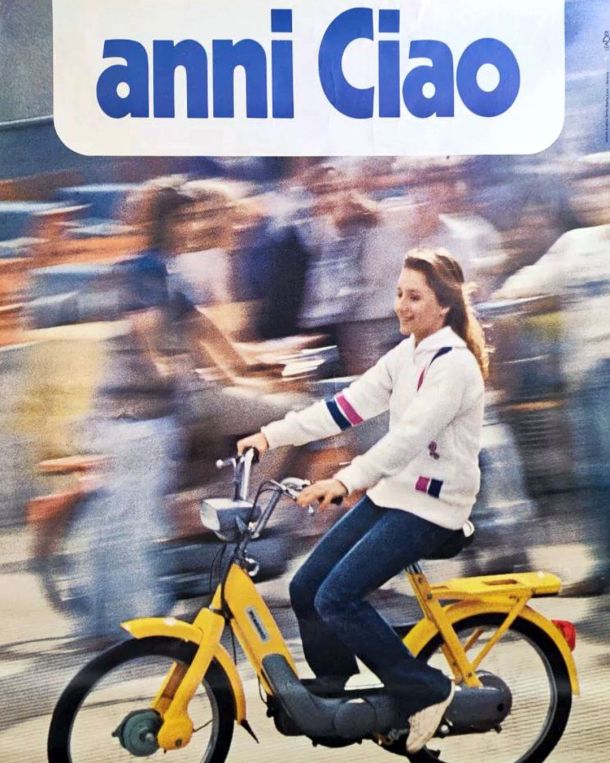
The Ciao Piaggio is not just a means of transport; It is a symbol of freedom and innovation that marked an unforgettable era in Italian history and beyond. Launched back in 1967 by the historic motorcycle manufacturer Piaggio, the Ciao represented a real revolution in the world of micro-mobility. With its minimalist design and state-of-the-art technical solutions, this moped has been able to win the hearts of entire generations, soon becoming much more than just a means of transport: a true cultural icon.
History and Context
The history of Ciao Piaggio is part of a context of profound social and cultural changes. The 60s and 70s were in fact a period of great turmoil in Italy, with economic growth leading to an increase in individual well-being and mobility. In this scenario, the Ciao stood out for its accessibility and practicality, offering young and old a new and liberating way to explore the city and the territory. Thanks to its mechanical simplicity and reliability, the Ciao has democratized mobility, allowing everyone to move freely without the need for special licenses or advanced technical knowledge.
Piaggio's intent was clear from the beginning: to create an accessible moped that was easy to use and maintain, suitable for a wide audience. This goal has been achieved through a series of technical and mechanical innovations that have made the Ciao a unique product of its kind.
Mechanical Innovations
The engine of the Ciao Piaggio represents one of its most significant innovations. This small, but powerful two-stroke engine was known for its lightness and reliability, two characteristics that made it a success. The mechanical simplicity of this engine not only made it easier to maintain, making it accessible even to the less experienced, but also helped to keep running costs low, an aspect particularly appreciated in an era of great economic and social changes. The ability to start easily, together with almost basic maintenance, has made the Ciao a particularly popular vehicle, capable of winning over a large slice of the public.
Its transmission system was also innovative. The Ciao Piaggio eliminated the need for manual gear changes thanks to its automatic transmission system, a real revolution for the time. This feature made the Ciao extremely easy and intuitive to ride, open to a much wider audience, including those who had never ridden a motorcycle before. This system not only simplified driving but contributed to greater safety, allowing drivers to focus more on the road and their surroundings.
The frame and design of the Ciao are equally emblematic. With its minimalist yet functional construction, the Ciao was both light and robust, a combination that guaranteed easy handling and durability. The design, simple and essential, was not only an aesthetic choice but reflected the intent to create a practical vehicle, suitable for everyday use, capable of responding to the needs of urban mobility and beyond. Its silhouette has become iconic, still representing an example of how design can positively influence the usability and aesthetics of a vehicle.
The ignition system of the Ciao also contributed to the reliability of the vehicle. By improving ignition efficiency, this system reduced the need for frequent maintenance, another point in favor of the simplicity and practicality that made the Ciao so popular. The ease with which it was possible to start the engine, in all weather conditions, demonstrates Piaggio's attention to details that concretely improve the driving experience.
Finally, Piaggio's attention to safety and comfort cannot be overlooked. The Ciao was equipped with a damping system that ensured a comfortable ride, even on less even surfaces, and a reliable braking system, both of which were crucial for the rider's safety. These characteristics, combined with the lightness and handling of the vehicle, have made the Ciao not only a practical and economical means of transport, but also safe and pleasant to drive.
Impact and Legacy
At a time when mobility was increasingly becoming a daily necessity, the Ciao Piaggio was able to meet the needs of an entire nation, becoming a faithful companion for urban adventures and beyond.
The mechanical innovations of the Ciao Piaggio were not mere technical improvements, but reflected a broader philosophy: to make personal mobility accessible, safe and enjoyable for everyone. This approach has guaranteed the Ciao a place of honor in the history of motorcycle design and technology, a position that Ambra Italy honors and carries forward with its restoration and transformation projects, projecting the Ciao into the future of electric mobility.Start of module
Photo: Piaggio & C. S.p.A. Archive
- E-BIKE TRANSFORMATION
- HISTORY OF CIAO PIAGGIO
- EVENTS
- ASSEMBLY OF KITS PURCHASED ONLINE
- OUR AUTHORIZED WORKSHOPS
- MAINTENANCE OF E-BIKES AMBRA ITALIA
- ELECTRIC MICRO-MOBILITY
- SCHOOL PROJECT: INNOVATING WITH AMBRA ITALIA
- ELEGANT AND SUSTAINABLE MOBILITY FOR RECEPTION STRUCTURES
- THE WORLD THROUGH CIAO: OUR CUSTOMERS' STORIES
- RESEARCH AND INNOVATION
- BEHIND THE SCENES OF AMBRA ITALIA
- Smart cities and vintage mobility: why the future may have roots in the past
- Differences between Ciao SC and PX series frames and impact on transformation
- The people of Ciao
- Ciao endothermic vs Ciao transformed into an e-bike: analysis of operating costs
- How to read and correctly interpret the Operating Instructions
- Because Ciao is beautiful
- Ciao Piaggio and women: a bond to tell
- Interview with a technician: what is it like to work on an electric Ciao?
- The Silence of the Myth – Pedal-Powered Emotions with an Electric Ciao
- Comparative Analysis of Environmental Impact: Ciao Piaggio Endothermic vs Ciao transformed into an E-Bike
- Safety First: Checking the Safety Systems on Ciao Transformed into E-Bikes
- The Longevity of E-Bikes: How Ambra Italia Extends the Life Cycle of the Ciao Piaggio
- The role of Ciao Piaggio transformed into an e-bike in the challenges of contemporary mobility
- Urban Efficiency: How the Ciao Piaggio transformed into E-Bikes by Ambra Italia revolutionize city spaces with style
- Navigating the Regulations: Current and Future Legislation on Electric Micro Mobility
- Post-Transformation Personalization: Opportunities and Limitations
- Ciao Restoration: Options and Tips
- Comparison between the efficiency of an internal combustion engine and an electric engine in mobility
- Building Long-Lasting Customer Relationships: Strategies for Workshops
- Electric rebirth: the Ciao Piaggio in the era of micro mobility
- Ciao Piaggio in cinema and pop culture
- Electricity System Integration: Challenges and Solutions
- Document Writing Philosophy: Everything Under Control
- Micro-Electric Mobility vs. Long-Distance Electric Mobility: Analysis and Perspectives
- The technology behind the myth: mechanical innovations of the Ciao Piaggio
- Compliance with Regulations: Safety and Certifications
- Steps towards Authorization: How to Become an Authorized Ambra Italia Workshop
- Cleaning and Care of your Ciao transformed into an E-Bike: Tips for Aesthetic Maintenance
- The Operating Instructions and Other Documents for the Assembly and Control of the Processes
- Micro Mobility and Social Responsibility: How Companies Can Make a Difference
- From work to free time: the Ciao Piaggio as a symbol of freedom
- The Materials Used
- From Niche to Mainstream: The Evolution of the Electric Micro Mobility Market
- Joining the Ambra Italia Network: Advantages and Opportunities for New Workshops
- Tests on Critical Components: battery and motor system
- Competing icons
- The Ciao and the urban mobility revolution
- E-Bike or electric motorbike? The choice of the type of transformation determines the approval
- The Role of Electric Micro-Mobility in Reducing Urban Pollution
- Collaborating to Innovate: The Flow of Information between Headquarters and Workshops
- Optimize the battery life of your Ambra Italia e-bike
- Quality Controls on Materials
- Design evolution
- Structural Problems
- Security and Micro Mobility. Standards and Recommended Practices for Electric Driving
- The Emoving Days 2024
- The components of the kit: panoramic
- Excellence in the service: Ambra Italia quality standards
- Basic maintenance of the Ambra Italia-Bike: step by step Guide for Newfits
- Keep the original design
- The future is here
- Birth of an icon