


Aesthetics, memory, and identity of an Italian icon
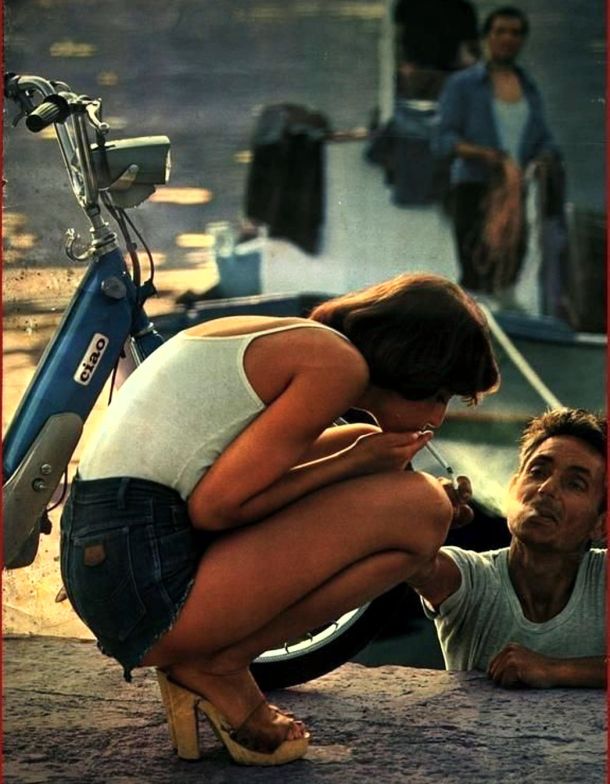
There is a scene that is repeated often, without us realizing it: a Ciao parked along a village road, leaning against a peeling wall, in front of a bar, next to a door, under a tree. It is not in the window, it is not displayed, it does not seek attention.
And yet, we look at it. And it seems beautiful to us. But why?
Why, after more than half a century, does such a simple moped continue to convey a sense of harmony, balance, familiarity? The answer lies not only in the design. It lies in the history of a country, in its streets, in its habits, in its transformations.
The Ciao is not designed to impress, but to function. Essential chassis, clean lines, components reduced to the essentials, no superfluous elements. It is the result of a great tradition of Italian design, one in which beauty comes from utility, not from ornament. In the Sixties, industrial Italy learned to build objects for everyone: cheap, reliable, repairable, destined to last. The Ciao was born in this context, like the Vespa, like the Olivetti cars, like the Fiat 500. Objects that do not shout, do not exhibit, do not seek consensus, but serve. And that's exactly why they become iconic.
When the Ciao arrives on the roads, Italy is changing. It is the country of the economic boom, of factories, of technical schools, of growing suburbs, of the province that opens to the world. For millions of people, moving is still not a given. Having your own vehicle means independence. The Ciao enters lives at this precise moment when freedom is not an acquired right but a daily conquest. He takes him to school, to work, to friends, to the sea, to his girlfriend. It becomes part of the routine. And what accompanies life ends up being part of it, intertwined with the simplest and truest memories.
It was not the medium of champions, nor that of the rich, nor that of stars. It was the vehicle of normal people. And here is one of his deepest secrets. Its beauty does not come from exception, but from everyday life. It was used by workers, students, employees, girls, fathers, mothers. With work clothes, with schoolbags, with shopping, with helmets hanging from the handlebars. He didn't ask to be different. He adapted to life. And in normality he found his strength.
The objects we use for years do not remain objects. They become containers of memories. A Ciao is never just a Ciao. It is the first means, the first freedom, the first journey alone, the summer of sixteen, the early morning work, the winter evenings. When we see it again, we don't just see metal. We see people, situations, emotions. We see fragments of our history. This is why it seems beautiful to us: because we recognize ourselves in him.
Looking at it today, the Ciao doesn't look old. It appears essential. In a world of overloaded, complex, digitized objects, his language is still legible. Frame, engine, wheels, movement. Everything is visible, everything is understandable. She is an honest beauty, who does not hide, does not pretend, does not promise more than what she offers. A beauty that comes from the coherence between form and function.
The electrical transformation does not distort the Ciao, rather it reveals its deepest nature. Silence, lightness, respect for space, soft mobility: these are contemporary values, but they were already in his DNA. Ambra Italia does not modernize an object, it continues its meaning. It shows that an icon can evolve without losing identity, while remaining true to its history.
The Ciao is beautiful because it never wanted to be. It is beautiful because it has been useful, because it has been close to people, because it has crossed generations without betraying them. It is beautiful because it tells of an Italy made of ingenuity, simplicity, dignity. An Italy that built to last, to serve, to accompany.
And, after all, this is the highest form of beauty: the one that remains, even when everything else changes.
Photo: Pinterest
- E-BIKE TRANSFORMATION
- HISTORY OF CIAO PIAGGIO
- EVENTS
- ASSEMBLY OF KITS PURCHASED ONLINE
- OUR AUTHORIZED WORKSHOPS
- MAINTENANCE OF E-BIKES AMBRA ITALIA
- ELECTRIC MICRO-MOBILITY
- SCHOOL PROJECT: INNOVATING WITH AMBRA ITALIA
- ELEGANT AND SUSTAINABLE MOBILITY FOR RECEPTION STRUCTURES
- THE WORLD THROUGH CIAO: OUR CUSTOMERS' STORIES
- RESEARCH AND INNOVATION
- BEHIND THE SCENES OF AMBRA ITALIA
- Smart cities and vintage mobility: why the future may have roots in the past
- Differences between Ciao SC and PX series frames and impact on transformation
- The people of Ciao
- Ciao endothermic vs Ciao transformed into an e-bike: analysis of operating costs
- How to read and correctly interpret the Operating Instructions
- Because Ciao is beautiful
- Ciao Piaggio and women: a bond to tell
- Interview with a technician: what is it like to work on an electric Ciao?
- The Silence of the Myth – Pedal-Powered Emotions with an Electric Ciao
- Comparative Analysis of Environmental Impact: Ciao Piaggio Endothermic vs Ciao transformed into an E-Bike
- Safety First: Checking the Safety Systems on Ciao Transformed into E-Bikes
- The Longevity of E-Bikes: How Ambra Italia Extends the Life Cycle of the Ciao Piaggio
- The role of Ciao Piaggio transformed into an e-bike in the challenges of contemporary mobility
- Urban Efficiency: How the Ciao Piaggio transformed into E-Bikes by Ambra Italia revolutionize city spaces with style
- Navigating the Regulations: Current and Future Legislation on Electric Micro Mobility
- Post-Transformation Personalization: Opportunities and Limitations
- Ciao Restoration: Options and Tips
- Comparison between the efficiency of an internal combustion engine and an electric engine in mobility
- Building Long-Lasting Customer Relationships: Strategies for Workshops
- Electric rebirth: the Ciao Piaggio in the era of micro mobility
- Ciao Piaggio in cinema and pop culture
- Electricity System Integration: Challenges and Solutions
- Document Writing Philosophy: Everything Under Control
- Micro-Electric Mobility vs. Long-Distance Electric Mobility: Analysis and Perspectives
- The technology behind the myth: mechanical innovations of the Ciao Piaggio
- Compliance with Regulations: Safety and Certifications
- Steps towards Authorization: How to Become an Authorized Ambra Italia Workshop
- Cleaning and Care of your Ciao transformed into an E-Bike: Tips for Aesthetic Maintenance
- The Operating Instructions and Other Documents for the Assembly and Control of the Processes
- Micro Mobility and Social Responsibility: How Companies Can Make a Difference
- From work to free time: the Ciao Piaggio as a symbol of freedom
- The Materials Used
- From Niche to Mainstream: The Evolution of the Electric Micro Mobility Market
- Joining the Ambra Italia Network: Advantages and Opportunities for New Workshops
- Tests on Critical Components: battery and motor system
- Competing icons
- The Ciao and the urban mobility revolution
- E-Bike or electric motorbike? The choice of the type of transformation determines the approval
- The Role of Electric Micro-Mobility in Reducing Urban Pollution
- Collaborating to Innovate: The Flow of Information between Headquarters and Workshops
- Optimize the battery life of your Ambra Italia e-bike
- Quality Controls on Materials
- Design evolution
- Structural Problems
- Security and Micro Mobility. Standards and Recommended Practices for Electric Driving
- The Emoving Days 2024
- The components of the kit: panoramic
- Excellence in the service: Ambra Italia quality standards
- Basic maintenance of the Ambra Italia-Bike: step by step Guide for Newfits
- Keep the original design
- The future is here
- Birth of an icon