


What is the environmental impact of an electric transformation compared to the traditional motor?
In the context of the ecological transition and the growing focus on sustainable mobility, it is crucial to analyse the differences between traditional vehicles and electrified solutions with objective criteria and measurable data. This study compares two versions of the famous Italian moped: the Ciao Piaggio mixture and the Ciao transformed into an e-bike by Ambra Italia. The aim is to provide a technical-environmental and economic overview throughout the life cycle of the two vehicles.
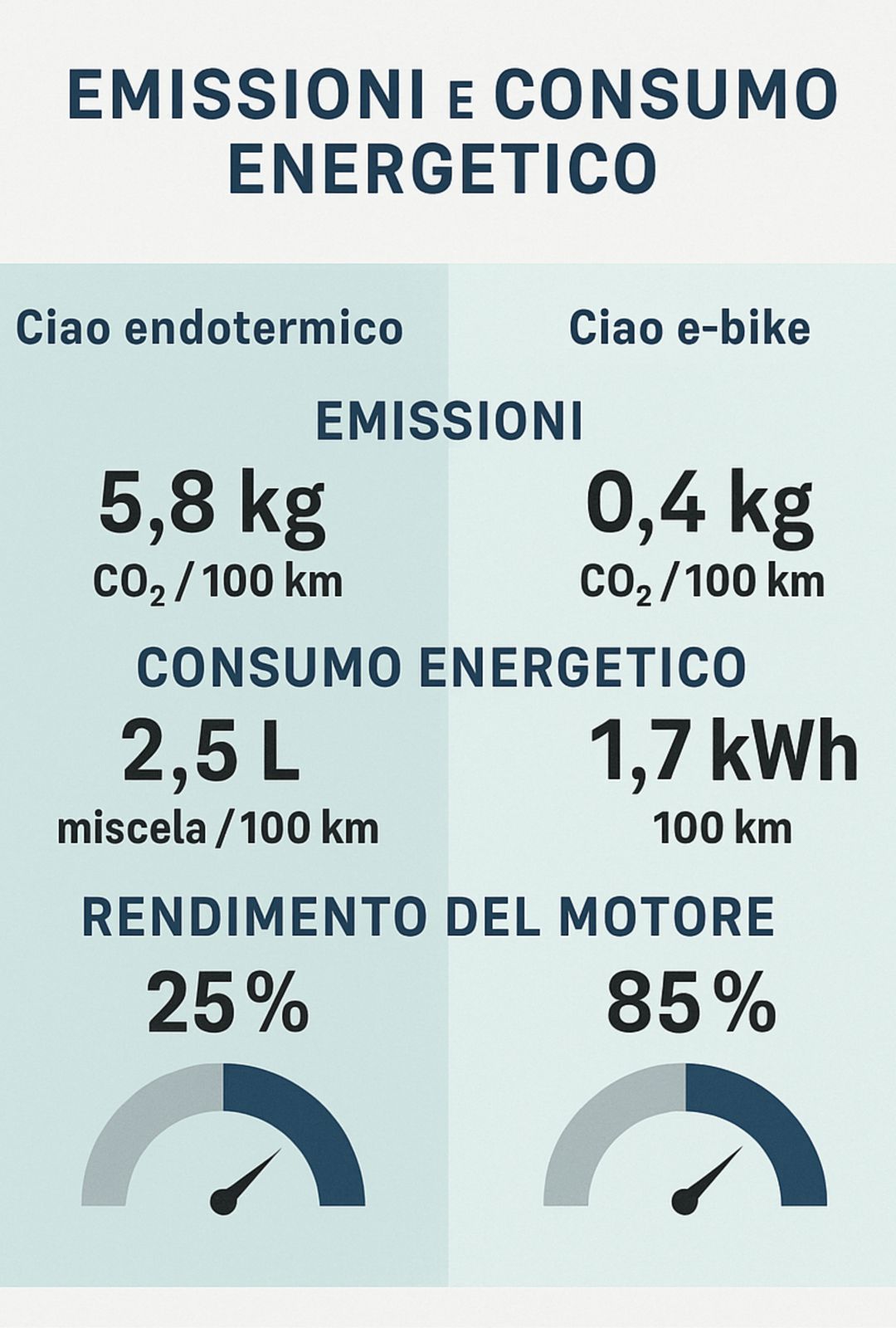
EMISSIONS AND ENERGY CONSUMPTION
Hello Endothermic
The internal combustion engine Ciao is powered by a petrol/oil mixture (2%). With an average consumption of 2.5 litres per 100 km, it produces around 5.8 kg of CO₂ per 100 km (source: ISPRA, estimated average emissions per petrol), to which is added a significant amount of fine particulate matter, carbon monoxide and unburned hydrocarbons, typical of small two-stroke engines, which are notoriously inefficient and lack abatement systems.
Ciao turned into an E-Bike
The electric version, powered by a 720 Wh (effective) lithium battery, consumes about 0.71 kWh for 42 km, corresponding to 1.7 kWh per 100 km. Considering an Italian average of emissions from electricity sources of about 230 g CO₂/kWh (GSE 2022 data), indirect emissions are equal to 0.4 kg of CO₂ per 100 km: more than 14 times lower than the thermal version.
IMPACT OF PRODUCTION AND END-OF-LIFE
Endothermic engine
Mixture mopeds contain mechanical components in steel and aluminum, whose production impact has already been amortized over the decades of use, but its end of life often coincides with scrapping.
In the case of the Ciao transformed into an e-bike, the frame is recovered and enhanced, avoiding new productions.
The production of lithium batteries is the critical issue. Building a 720 Wh battery results in an estimated 40–60 kg of CO₂ emissions (source: Transport & Environment, 2020). However, with a service life of around 800–1000 charging cycles, the impact is spread over more than 30,000–40,000 km of use, making the cumulative effect significantly lower than that of a blended vehicle, even in a conservative-
Battery Recycling (Source: COBAT)
The COBAT (National Collection and Recycling Consortium) claims that in the near future, more than 95% of the materials in lithium-ion batteries can be recovered. This allows sustainable end-of-life management, limiting hazardous waste and promoting a virtuous cycle of circular economy. The traceability of waste and the recovery of strategic materials represent a significant added value in the overall environmental balance.
CHARGING ENERGY AND INFRASTRUCTURE
Ambra Italia e-bikes can be recharged via a normal 220V domestic socket, eliminating the need for dedicated stations. Each full charging cycle costs around €0.20 (estimating €0.30/kWh), making the system extremely affordable. In addition, the existing electrical infrastructure is fully sufficient to support the widespread charging of these vehicles, without requiring new networks or public investment.
COMPARATIVE ECONOMIC ANALYSIS
In terms of operating costs, the traditional Ciao consumes 2.5 litres of mixture per 100 km, corresponding to about € 4.00 (at the current average price of petrol). TTo this must be added the maintenance costs of the engine and transmission.
The e-bike consumes 1.71 kWh/100 km, which is equivalent to about €0.40 (estimated €0.23/kWh). Maintenance is easier and less frequent. Even considering a battery replacement cost after a few years, the total costs are significantly lower on a multi-year scale.
The comparative analysis between the endothermic Ciao and its electric version clearly highlights the environmental, energy and economic superiority of the converted vehicle. Switching to electric means a drastic reduction in CO₂ emissions, fossil fuel consumption and some waste. In addition, the recovery and use of existing mopeds saves resources in production and reduces the impact of the end of life.
Thanks to the support of recycling systems such as COBAT, the impact of batteries can also be effectively managed, helping to close the circle from a circular economy perspective.
SOURCES
- ISPRA – National Emission Inventory
- GSE – Data on the Italian national electricity mix
- COBAT – 2023 Battery Collection Report
- ENEA – Comparative studies on electricity consumption for mobility
- Ambra Italia – Proprietary technical data relating to conversions
- E-BIKE TRANSFORMATION
- HISTORY OF CIAO PIAGGIO
- EVENTS
- ASSEMBLY OF KITS PURCHASED ONLINE
- OUR AUTHORIZED WORKSHOPS
- MAINTENANCE OF E-BIKES AMBRA ITALIA
- ELECTRIC MICRO-MOBILITY
- SCHOOL PROJECT: INNOVATING WITH AMBRA ITALIA
- ELEGANT AND SUSTAINABLE MOBILITY FOR RECEPTION STRUCTURES
- THE WORLD THROUGH CIAO: OUR CUSTOMERS' STORIES
- RESEARCH AND INNOVATION
- BEHIND THE SCENES OF AMBRA ITALIA
- Smart cities and vintage mobility: why the future may have roots in the past
- Differences between Ciao SC and PX series frames and impact on transformation
- The people of Ciao
- Ciao endothermic vs Ciao transformed into an e-bike: analysis of operating costs
- How to read and correctly interpret the Operating Instructions
- Because Ciao is beautiful
- Ciao Piaggio and women: a bond to tell
- Interview with a technician: what is it like to work on an electric Ciao?
- The Silence of the Myth – Pedal-Powered Emotions with an Electric Ciao
- Comparative Analysis of Environmental Impact: Ciao Piaggio Endothermic vs Ciao transformed into an E-Bike
- Safety First: Checking the Safety Systems on Ciao Transformed into E-Bikes
- The Longevity of E-Bikes: How Ambra Italia Extends the Life Cycle of the Ciao Piaggio
- The role of Ciao Piaggio transformed into an e-bike in the challenges of contemporary mobility
- Urban Efficiency: How the Ciao Piaggio transformed into E-Bikes by Ambra Italia revolutionize city spaces with style
- Navigating the Regulations: Current and Future Legislation on Electric Micro Mobility
- Post-Transformation Personalization: Opportunities and Limitations
- Ciao Restoration: Options and Tips
- Comparison between the efficiency of an internal combustion engine and an electric engine in mobility
- Building Long-Lasting Customer Relationships: Strategies for Workshops
- Electric rebirth: the Ciao Piaggio in the era of micro mobility
- Ciao Piaggio in cinema and pop culture
- Electricity System Integration: Challenges and Solutions
- Document Writing Philosophy: Everything Under Control
- Micro-Electric Mobility vs. Long-Distance Electric Mobility: Analysis and Perspectives
- The technology behind the myth: mechanical innovations of the Ciao Piaggio
- Compliance with Regulations: Safety and Certifications
- Steps towards Authorization: How to Become an Authorized Ambra Italia Workshop
- Cleaning and Care of your Ciao transformed into an E-Bike: Tips for Aesthetic Maintenance
- The Operating Instructions and Other Documents for the Assembly and Control of the Processes
- Micro Mobility and Social Responsibility: How Companies Can Make a Difference
- From work to free time: the Ciao Piaggio as a symbol of freedom
- The Materials Used
- From Niche to Mainstream: The Evolution of the Electric Micro Mobility Market
- Joining the Ambra Italia Network: Advantages and Opportunities for New Workshops
- Tests on Critical Components: battery and motor system
- Competing icons
- The Ciao and the urban mobility revolution
- E-Bike or electric motorbike? The choice of the type of transformation determines the approval
- The Role of Electric Micro-Mobility in Reducing Urban Pollution
- Collaborating to Innovate: The Flow of Information between Headquarters and Workshops
- Optimize the battery life of your Ambra Italia e-bike
- Quality Controls on Materials
- Design evolution
- Structural Problems
- Security and Micro Mobility. Standards and Recommended Practices for Electric Driving
- The Emoving Days 2024
- The components of the kit: panoramic
- Excellence in the service: Ambra Italia quality standards
- Basic maintenance of the Ambra Italia-Bike: step by step Guide for Newfits
- Keep the original design
- The future is here
- Birth of an icon