


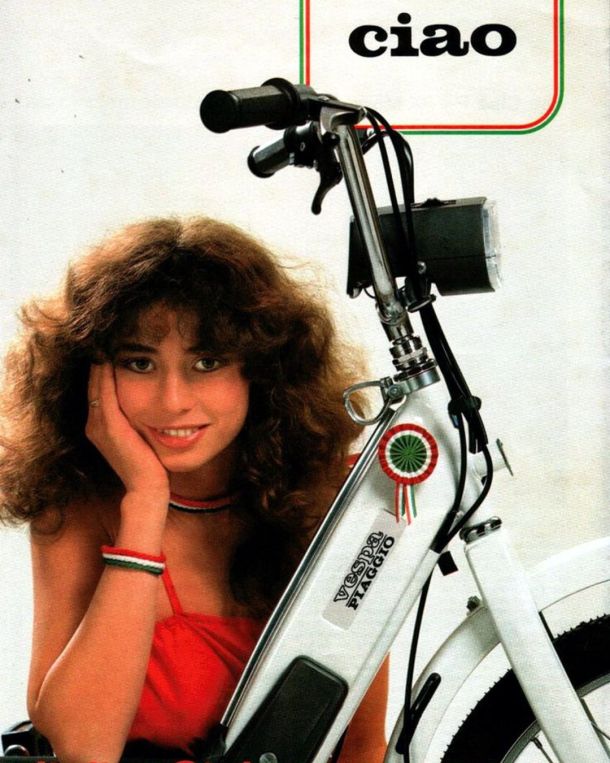
There is an image that, in Italy, crosses generations without the need for explanations: a village road, a provincial town, a summer afternoon... and a Ciao that passes lightly, almost on tiptoe. Inside that image, often, there is a girl. Not because of "exception", but because the Ciao — more than many other means — was also this: a form of daily, accessible, concrete, normal freedom.
Telling the story of the link between Ciao Piaggio and women does not mean chasing a slogan. It means focusing on a piece of Italian social history: how mobility changes, how customs change, how the real possibilities of moving, choosing, working, going out, living change.
A moped born at the right time
The Piaggio Ciao was presented to the public on 11 October 1967 in Genoa, at the Fiera del Mare, and remained in production until 2006.
But its success is not only technical or commercial: it is cultural. The Ciao arrives in an Italy that is changing: more schools, more work, more travel. And, above all, more desire for autonomy.
Freedom, but without noise: why the Ciao "worked" for women too
To understand why so many girls and women have chosen Ciao, we need to get rid of clichés. It is not a question of "female means". It's a matter of intelligent design.
The Ciao was:
- light and manageable (even by those who were not familiar with more demanding vehicles)
- Simple to use and maintain
- Clean in design, essential, not aggressive
- Versatile: city, short journeys, errands, school, work
- very cheap compared to more "adult" alternatives (more expensive cars and scooters)
And above all: it was a medium that did not ask to "become someone else" to use it. There was no need to adopt a motorcyclist identity. It was enough to get on and go.
"Liberi chi Ciao": when advertising talks about autonomy
In the 1970s, Piaggio launched one of its most famous campaigns, that of the "Sardinian-Furniture": the car as a tin can, the two-wheeler as open space, air, freedom. The claim "Sardinian furniture has tin skies. Free who Ciao" has become proverbial.
Interestingly, that message is not "speed," it is not "power," it is not "challenge." It is mobility as emancipation. A promise that also speaks very well to the female world of the time, which was conquering new spaces — often in small steps, but real.
Mobility and customs: the Ciao as a "key" to everyday life
If we think of the culture of those years, freedom is not always a heroic gesture. Much more often it is a practical gesture:
- Getting to school without depending on anyone
- Getting to work with your own vehicle
- go out in the evening and come back without asking for rides
- Moving around the city avoiding traffic and schedules
In this sense, the Ciao is part of the same great history of "light" modernization that, already with the bicycle, had also crossed processes of social transformation and emancipation. The Ciao inherits that "democracy" of mobility and takes it a step further: engine, autonomy, wider range of action.
Mothers, daughters, sisters: an emotional object even before being mechanical
There is a detail that anyone who lived through that period recognizes: the Ciao was not just "someone's". It was often family-owned.
And when an object enters habits, it also enters memory: photographs, stories, nicknames, small but decisive journeys. The Ciao ends up being linked to moments of personal growth: the first independence, the first summer as "adults", the first job, the first real freedom.
For many women, it was a means without rhetoric, but full of meaning: not shouted rebellion, but built autonomy.
A myth that also lives in the places of history
Today the Ciao is not "just nostalgia": it is a recognized piece of industrial and cultural heritage. It is no coincidence that it appears in museum collections and narratives, such as at the Piaggio Museum (Pontedera), where it is presented as a key step in the evolution of Piaggio mobility.
The myth resists because the project was right. And because that project really moved people — including women — in an Italy where moving often meant gaining time and possibilities.
A freedom that continues: today's women, electric mobility, Ambra Italia
Today, women move in a different world, but they face a surprisingly similar challenge: to conquer freedom without sacrificing identity, elegance, and awareness. Electric mobility was born right here — not as a fashion, but as an intelligent response to a more careful, more sustainable, more humane way of life.
In this scenario, the Ciao that is reborn in an e-bike version is not a nostalgic operation. It is a cultural choice.
It is the idea that technology should serve the person, not dominate him. That innovation can be silent, respectful, consistent with who we are.
Ambra Italia starts right here: from the belief that Italian design, historical memory, and sustainable mobility can coexist without compromise. That a vehicle can be beautiful without being ostentatious. That he can tell a story without raising his voice.
For many women today, choosing stylish electric mobility means affirming a value:
- Respect for the environment
- respect for urban space
- self-respect
It is the same value that, decades ago, led a girl to get on a Ciao to go where she wanted, when she wanted.
Technologies change. Cities change. But authentic freedom always remains the same: to move according to one's own measure.
And perhaps this is precisely the invisible thread that unites past and present. The Ciao never promised to be the loudest, the fastest, the most flashy. He always promised something rarer.
To be at the service of freedom.
Header photo: Mynumi.net
Article photo: Piaggio & C. S.p.A archive.
- E-BIKE TRANSFORMATION
- HISTORY OF CIAO PIAGGIO
- EVENTS
- ASSEMBLY OF KITS PURCHASED ONLINE
- OUR AUTHORIZED WORKSHOPS
- MAINTENANCE OF E-BIKES AMBRA ITALIA
- ELECTRIC MICRO-MOBILITY
- SCHOOL PROJECT: INNOVATING WITH AMBRA ITALIA
- ELEGANT AND SUSTAINABLE MOBILITY FOR RECEPTION STRUCTURES
- THE WORLD THROUGH CIAO: OUR CUSTOMERS' STORIES
- RESEARCH AND INNOVATION
- BEHIND THE SCENES OF AMBRA ITALIA
- Smart cities and vintage mobility: why the future may have roots in the past
- Differences between Ciao SC and PX series frames and impact on transformation
- The people of Ciao
- Ciao endothermic vs Ciao transformed into an e-bike: analysis of operating costs
- How to read and correctly interpret the Operating Instructions
- Because Ciao is beautiful
- Ciao Piaggio and women: a bond to tell
- Interview with a technician: what is it like to work on an electric Ciao?
- The Silence of the Myth – Pedal-Powered Emotions with an Electric Ciao
- Comparative Analysis of Environmental Impact: Ciao Piaggio Endothermic vs Ciao transformed into an E-Bike
- Safety First: Checking the Safety Systems on Ciao Transformed into E-Bikes
- The Longevity of E-Bikes: How Ambra Italia Extends the Life Cycle of the Ciao Piaggio
- The role of Ciao Piaggio transformed into an e-bike in the challenges of contemporary mobility
- Urban Efficiency: How the Ciao Piaggio transformed into E-Bikes by Ambra Italia revolutionize city spaces with style
- Navigating the Regulations: Current and Future Legislation on Electric Micro Mobility
- Post-Transformation Personalization: Opportunities and Limitations
- Ciao Restoration: Options and Tips
- Comparison between the efficiency of an internal combustion engine and an electric engine in mobility
- Building Long-Lasting Customer Relationships: Strategies for Workshops
- Electric rebirth: the Ciao Piaggio in the era of micro mobility
- Ciao Piaggio in cinema and pop culture
- Electricity System Integration: Challenges and Solutions
- Document Writing Philosophy: Everything Under Control
- Micro-Electric Mobility vs. Long-Distance Electric Mobility: Analysis and Perspectives
- The technology behind the myth: mechanical innovations of the Ciao Piaggio
- Compliance with Regulations: Safety and Certifications
- Steps towards Authorization: How to Become an Authorized Ambra Italia Workshop
- Cleaning and Care of your Ciao transformed into an E-Bike: Tips for Aesthetic Maintenance
- The Operating Instructions and Other Documents for the Assembly and Control of the Processes
- Micro Mobility and Social Responsibility: How Companies Can Make a Difference
- From work to free time: the Ciao Piaggio as a symbol of freedom
- The Materials Used
- From Niche to Mainstream: The Evolution of the Electric Micro Mobility Market
- Joining the Ambra Italia Network: Advantages and Opportunities for New Workshops
- Tests on Critical Components: battery and motor system
- Competing icons
- The Ciao and the urban mobility revolution
- E-Bike or electric motorbike? The choice of the type of transformation determines the approval
- The Role of Electric Micro-Mobility in Reducing Urban Pollution
- Collaborating to Innovate: The Flow of Information between Headquarters and Workshops
- Optimize the battery life of your Ambra Italia e-bike
- Quality Controls on Materials
- Design evolution
- Structural Problems
- Security and Micro Mobility. Standards and Recommended Practices for Electric Driving
- The Emoving Days 2024
- The components of the kit: panoramic
- Excellence in the service: Ambra Italia quality standards
- Basic maintenance of the Ambra Italia-Bike: step by step Guide for Newfits
- Keep the original design
- The future is here
- Birth of an icon