


Fitting an Ambra Italia Kit on a Ciao Piaggio requires attention, precision, and awareness. For this reason, each phase of the work is accompanied by an Operational Instruction (I.O.) that guides the fitter step by step, avoiding errors and ensuring a safe and standard-compliant transformation.
But how do you really read these instructions? In this article, we explain how to interpret them correctly, how to distinguish essential information from in-depth information, and why it is important not to skip any steps.
What are Operating Instructions?
The Ambra Italia Operating Instructions are numbered technical documents (from I.O.001 to I.O.005) that explain in detail how to transform a Ciao into an e-bike, dividing the work into ordered modules:
- I.O.001 → Frame Preparation
- I.O.002 → Battery Compartment
- I.O.003 → Electrical System
- I.O.004 → Rear Axle
- I.O.005 → Frame Assembly
Each document contains explanatory texts, photographs, technical drawings, and notes. Some also include appendices with insights into special cases or differences between the SC and PX series.
How to orient yourself in reading
- Read everything first, then start the work
Before using the tools, it is essential to read all the Operating Instructions carefully. Some operations are irreversible, and anticipating a step can cause problems.
Another essential tool is the Processing and Controls Sheet, a sequential list of all operations and checks, each related to the relevant operating instruction.
- Look carefully at the photographs
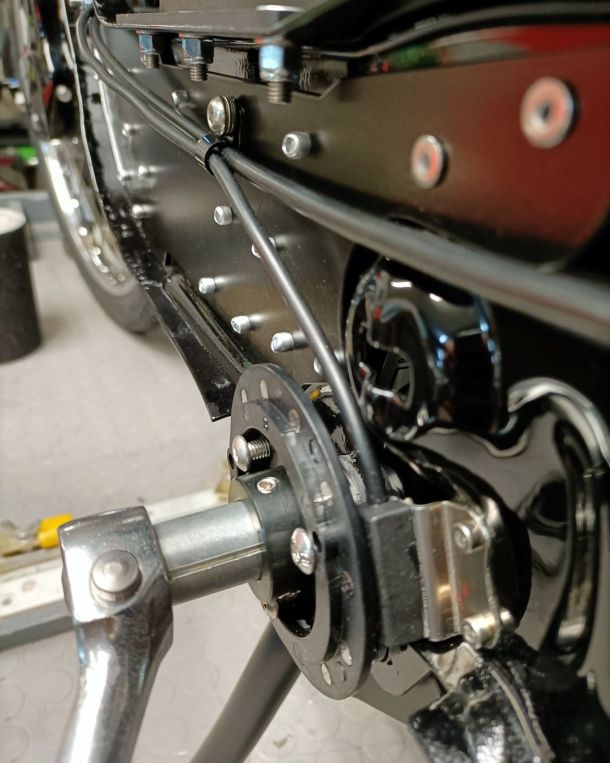
Images are not just illustrations: they are visual instructions.
Details such as the location of the holes, the type of screw or the inclination of the wiring are often clearer in the image than in the text.
- Take into account the series of your Ciao
In some steps (especially in the I.O.001, I.O.003 and I.O.005), the instructions vary depending on whether the frame belongs to the SC or PX series.
→ Example: the horns are mounted differently in the two models, as well as the right reinforcement sides, which have different holes.
Useful symbols and conventions
- Tools and notes on the work → explicitly indicated at the beginning of each I.O.
- Notes of caution → highlight critical operations (e.g. drilling, milling, electrical connections)
- Dimensions and measurements → to be respected with millimeter precision
- Schematic colors → help identify components (e.g. right side in yellow)
Appendices and special cases
Never neglect the final appendages: they are essential for older frames.→ Example: Appendix 1 of I.O.001 explains how to work on SC frames that do not have a spool housing — a detail not visible in the main part of the instruction.
Do you have any doubts? Contact Support
Ambra Italia provides telephone assistance to help those who assemble the Kit independently. A direct confrontation before starting work is highly recommended, especially to clarify any doubts or deepen delicate operations.
The Operating Instructions are not simple "manuals": they are the technical heart of the Ambra Italia project. Reading them carefully, respecting the sequence of steps and understanding the differences between the versions of the Ciao is what makes the difference between an approximate assembly and a professional transformation.
Those who know their chassis and interpret I.O. correctly have already done half the work.
⚠️ Important note
The Ambra Italia Operating Instructions are designed to clearly guide those who want to transform a Ciao into an e-bike with our Kit.
Some phases require manual dexterity, precision, and adequate tools. If you are not experienced with technical interventions of this type, we recommend that you contact an authorized workshop or contact us for assistance. Following the instructions correctly is essential to ensure the safety, efficiency, and durability of your vehicle.
- E-BIKE TRANSFORMATION
- HISTORY OF CIAO PIAGGIO
- EVENTS
- ASSEMBLY OF KITS PURCHASED ONLINE
- OUR AUTHORIZED WORKSHOPS
- MAINTENANCE OF E-BIKES AMBRA ITALIA
- ELECTRIC MICRO-MOBILITY
- SCHOOL PROJECT: INNOVATING WITH AMBRA ITALIA
- ELEGANT AND SUSTAINABLE MOBILITY FOR RECEPTION STRUCTURES
- THE WORLD THROUGH CIAO: OUR CUSTOMERS' STORIES
- RESEARCH AND INNOVATION
- BEHIND THE SCENES OF AMBRA ITALIA
- Smart cities and vintage mobility: why the future may have roots in the past
- Differences between Ciao SC and PX series frames and impact on transformation
- The people of Ciao
- Ciao endothermic vs Ciao transformed into an e-bike: analysis of operating costs
- How to read and correctly interpret the Operating Instructions
- Because Ciao is beautiful
- Ciao Piaggio and women: a bond to tell
- Interview with a technician: what is it like to work on an electric Ciao?
- The Silence of the Myth – Pedal-Powered Emotions with an Electric Ciao
- Comparative Analysis of Environmental Impact: Ciao Piaggio Endothermic vs Ciao transformed into an E-Bike
- Safety First: Checking the Safety Systems on Ciao Transformed into E-Bikes
- The Longevity of E-Bikes: How Ambra Italia Extends the Life Cycle of the Ciao Piaggio
- The role of Ciao Piaggio transformed into an e-bike in the challenges of contemporary mobility
- Urban Efficiency: How the Ciao Piaggio transformed into E-Bikes by Ambra Italia revolutionize city spaces with style
- Navigating the Regulations: Current and Future Legislation on Electric Micro Mobility
- Post-Transformation Personalization: Opportunities and Limitations
- Ciao Restoration: Options and Tips
- Comparison between the efficiency of an internal combustion engine and an electric engine in mobility
- Building Long-Lasting Customer Relationships: Strategies for Workshops
- Electric rebirth: the Ciao Piaggio in the era of micro mobility
- Ciao Piaggio in cinema and pop culture
- Electricity System Integration: Challenges and Solutions
- Document Writing Philosophy: Everything Under Control
- Micro-Electric Mobility vs. Long-Distance Electric Mobility: Analysis and Perspectives
- The technology behind the myth: mechanical innovations of the Ciao Piaggio
- Compliance with Regulations: Safety and Certifications
- Steps towards Authorization: How to Become an Authorized Ambra Italia Workshop
- Cleaning and Care of your Ciao transformed into an E-Bike: Tips for Aesthetic Maintenance
- The Operating Instructions and Other Documents for the Assembly and Control of the Processes
- Micro Mobility and Social Responsibility: How Companies Can Make a Difference
- From work to free time: the Ciao Piaggio as a symbol of freedom
- The Materials Used
- From Niche to Mainstream: The Evolution of the Electric Micro Mobility Market
- Joining the Ambra Italia Network: Advantages and Opportunities for New Workshops
- Tests on Critical Components: battery and motor system
- Competing icons
- The Ciao and the urban mobility revolution
- E-Bike or electric motorbike? The choice of the type of transformation determines the approval
- The Role of Electric Micro-Mobility in Reducing Urban Pollution
- Collaborating to Innovate: The Flow of Information between Headquarters and Workshops
- Optimize the battery life of your Ambra Italia e-bike
- Quality Controls on Materials
- Design evolution
- Structural Problems
- Security and Micro Mobility. Standards and Recommended Practices for Electric Driving
- The Emoving Days 2024
- The components of the kit: panoramic
- Excellence in the service: Ambra Italia quality standards
- Basic maintenance of the Ambra Italia-Bike: step by step Guide for Newfits
- Keep the original design
- The future is here
- Birth of an icon