
There is a kind of time that cannot be measured by a clock. A time that doesn’t pass but walks beside us.
It can’t be calculated, but it can be inhabited. It’s the time of slowness.
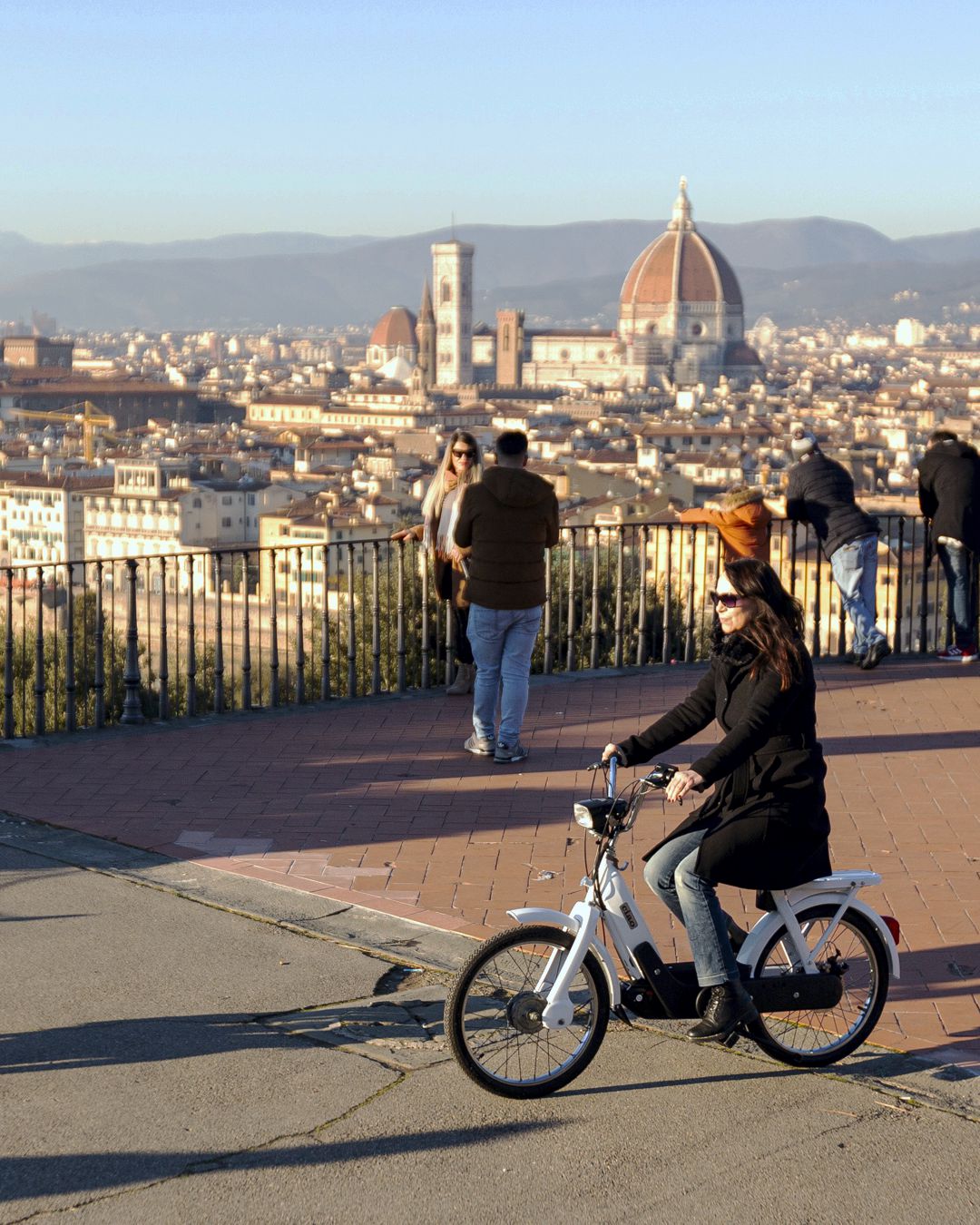
In the age of immediacy, of “now,” of movement as acceleration, there is still space for a kind of mobility that doesn’t chase speed but gives meaning back to the journey. A mobility that, rather than simply moving us, carries us. Our thoughts, our moods, our memories.
Moving—even with the assistance of an electric motor—is not just a physical action.
It is a gesture with rhythm, a pace that allows space for listening: to the road, to what happens around us, and to what stirs within us.
Those who choose a light, essential vehicle, often without haste, are not giving up on speed — they are choosing their own. A speed that doesn’t isolate but connects. To the landscape. To the city. To one’s own thoughts.
We live in a world where slowness is often misunderstood.
It is seen as inefficiency, a waste of time. But perhaps the opposite is true: slowness is care.
It is the willingness to stay where we are, even just a moment longer.
Two wheels — especially when they whisper instead of roar — return us to a human dimension of movement. Lower than traffic, higher than noise.
In urban mobility, increasingly compressed and breathless, we have lost the sense of the journey.
We go from A to B, no longer aware of what lies between. Slowness reopens that “between.”
It fills it with meaning, with observation, with presence. Even with beauty.
Every curve, every hill, every stop at a traffic light can become a point of contact with the world — or with ourselves.
Choosing a slow, silent, essential vehicle is not only a technical or economic decision.
It is often a cultural one. A declaration, even if silent, of values:
care, respect, simplicity, and quality that lasts.
In a time when everything must arrive first, those who slow down become visible.
Not because they’re left behind, but because they’ve chosen to look elsewhere.
Time in the saddle is not time wasted.
It is full time.
Time lived.
And sometimes, it is in the slowness of movement that we find the most authentic part of the journey.
- E-BIKE TRANSFORMATION
- HISTORY OF CIAO PIAGGIO
- EVENTS
- ASSEMBLY OF KITS PURCHASED ONLINE
- OUR AUTHORIZED WORKSHOPS
- MAINTENANCE OF E-BIKES AMBRA ITALIA
- ELECTRIC MICRO-MOBILITY
- SCHOOL PROJECT: INNOVATING WITH AMBRA ITALIA
- ELEGANT AND SUSTAINABLE MOBILITY FOR RECEPTION STRUCTURES
- THE WORLD THROUGH CIAO: OUR CUSTOMERS' STORIES
- RESEARCH AND INNOVATION
- BEHIND THE SCENES OF AMBRA ITALIA
- Differences between Ciao SC and PX series frames and impact on transformation
- The people of Ciao
- Ciao endothermic vs Ciao transformed into an e-bike: analysis of operating costs
- How to read and correctly interpret the Operating Instructions
- Because Ciao is beautiful
- Ciao Piaggio and women: a bond to tell
- Interview with a technician: what is it like to work on an electric Ciao?
- The Silence of the Myth – Pedal-Powered Emotions with an Electric Ciao
- Comparative Analysis of Environmental Impact: Ciao Piaggio Endothermic vs Ciao transformed into an E-Bike
- Safety First: Checking the Safety Systems on Ciao Transformed into E-Bikes
- The Longevity of E-Bikes: How Ambra Italia Extends the Life Cycle of the Ciao Piaggio
- The role of Ciao Piaggio transformed into an e-bike in the challenges of contemporary mobility
- Urban Efficiency: How the Ciao Piaggio transformed into E-Bikes by Ambra Italia revolutionize city spaces with style
- Navigating the Regulations: Current and Future Legislation on Electric Micro Mobility
- Post-Transformation Personalization: Opportunities and Limitations
- Ciao Restoration: Options and Tips
- Comparison between the efficiency of an internal combustion engine and an electric engine in mobility
- Building Long-Lasting Customer Relationships: Strategies for Workshops
- Electric rebirth: the Ciao Piaggio in the era of micro mobility
- Ciao Piaggio in cinema and pop culture
- Electricity System Integration: Challenges and Solutions
- Document Writing Philosophy: Everything Under Control
- Micro-Electric Mobility vs. Long-Distance Electric Mobility: Analysis and Perspectives
- The technology behind the myth: mechanical innovations of the Ciao Piaggio
- Compliance with Regulations: Safety and Certifications
- Steps towards Authorization: How to Become an Authorized Ambra Italia Workshop
- Cleaning and Care of your Ciao transformed into an E-Bike: Tips for Aesthetic Maintenance
- The Operating Instructions and Other Documents for the Assembly and Control of the Processes
- Micro Mobility and Social Responsibility: How Companies Can Make a Difference
- From work to free time: the Ciao Piaggio as a symbol of freedom
- The Materials Used
- From Niche to Mainstream: The Evolution of the Electric Micro Mobility Market
- Joining the Ambra Italia Network: Advantages and Opportunities for New Workshops
- Tests on Critical Components: battery and motor system
- Competing icons
- The Ciao and the urban mobility revolution
- E-Bike or electric motorbike? The choice of the type of transformation determines the approval
- The Role of Electric Micro-Mobility in Reducing Urban Pollution
- Collaborating to Innovate: The Flow of Information between Headquarters and Workshops
- Optimize the battery life of your Ambra Italia e-bike
- Quality Controls on Materials
- Design evolution
- Structural Problems
- Security and Micro Mobility. Standards and Recommended Practices for Electric Driving
- The Emoving Days 2024
- The components of the kit: panoramic
- Excellence in the service: Ambra Italia quality standards
- Basic maintenance of the Ambra Italia-Bike: step by step Guide for Newfits
- Keep the original design
- The future is here
- Birth of an icon