
There comes a moment, in the life of objects, when time ceases to be a measure and becomes a test.
A test of resistance, certainly—but also of meaning.
Not everything that passes through the years manages to remain.
Many forms wear out, others transform until they become unrecognizable. Some simply disappear.
And then there are those that endure without imposing themselves, that return without noise, that continue to speak even when the world around them has changed its language.
These are the forms that endure.
Not because they are perfect.
But because they are right.
We live in an age that has made speed a virtue and obsolescence an unwritten rule.
Every object is born with a predetermined end, every technology seems designed to be surpassed in the shortest possible time.
And yet, precisely within this scenario, a different tension emerges.
A return.
Not nostalgic, not conservative, but deeply contemporary.
It is a return to what truly works.
To what has been intelligently conceived, built with balance, used with natural ease.
To what does not need to be reinvented every year to retain its value.
There are objects that do not belong to a specific era, but to a culture.
Objects that have crossed generations without losing their identity, becoming part of everyday landscapes and collective memory.
They are not merely tools.
They are silent symbols of a way of living.
A way in which simplicity is not a renunciation, but a synthesis.
Where lightness is not fragility, but design intelligence.
Where durability is not accidental, but the result of a vision.
To recover these forms today does not mean looking backward.
It means recognizing what, over time, has proven it still has something to say.
It means taking value away from the logic of disposal and restoring it to continuity.
It means choosing not to constantly chase the new, but to understand what already exists.
And above all, it means having the courage to intervene without betraying.
Because the real point is not to preserve.
It is to transform with respect.
To integrate innovation without erasing identity.
To add technology without compromising balance.
To bring into the present what was born in the past, without forcing it to become something else.
It is a subtle craft.
It requires measure, sensitivity, and a clear vision of what must be preserved.
In this sense, the return of enduring forms is not a trend.
It is a cultural choice.
It is the will to build a different relationship with objects, less tied to consumption and more oriented toward connection.
It is the desire to inhabit time, rather than chase it.
And perhaps, ultimately, it is also a response.
To a world that changes too quickly,
to a technology that often forgets what is essential,
to a mobility that risks losing touch with its most human dimension.
Enduring forms remind us that another rhythm exists.
Slower, yet no less effective.
Simpler, yet no less evolved.
More essential, yet no less contemporary.
A rhythm in which innovation and memory do not exclude one another, but strengthen each other.
Between past and present there is no fracture.
There is a bridge.
And crossing it, today, is a choice.
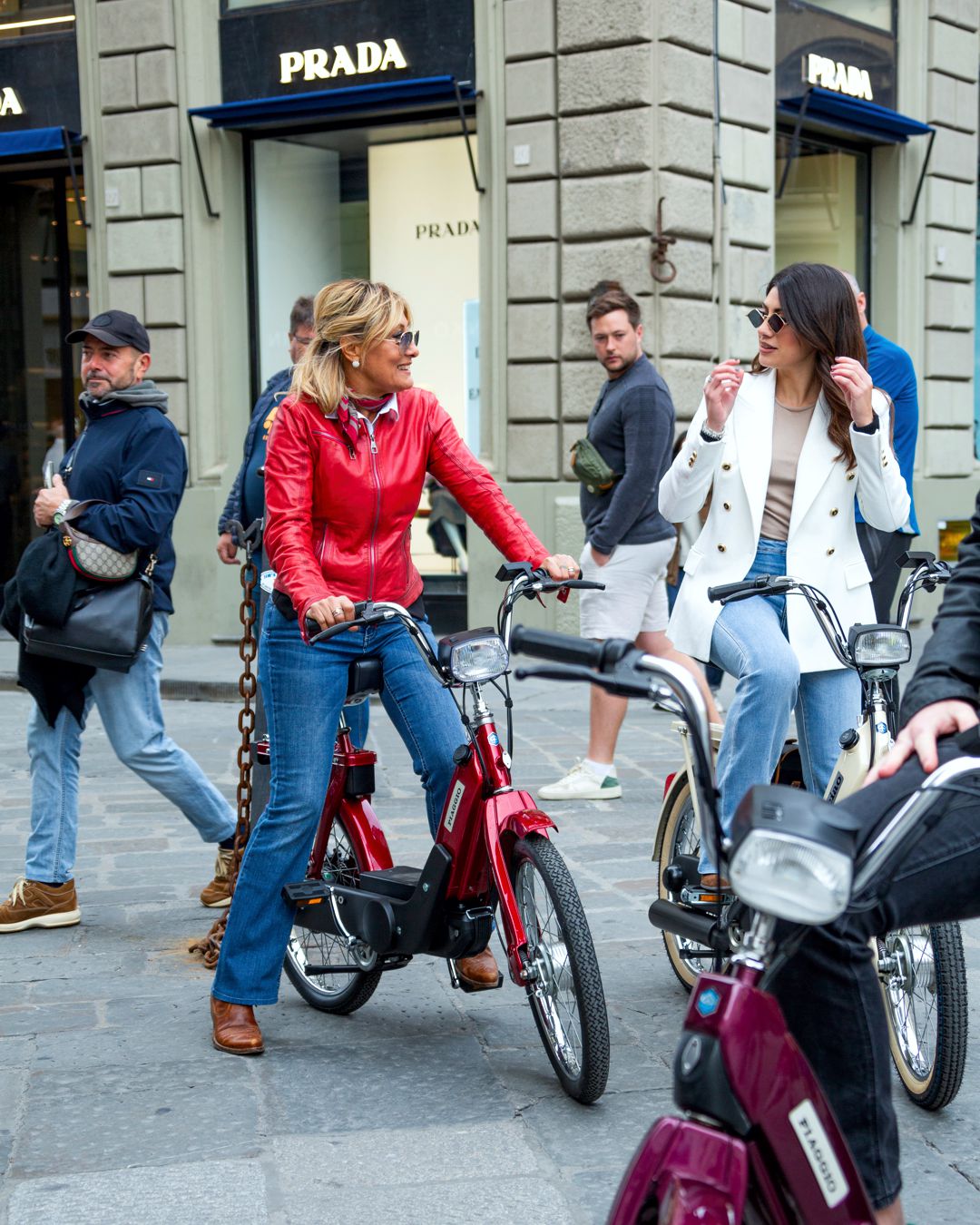
- E-BIKE TRANSFORMATION
- HISTORY OF CIAO PIAGGIO
- EVENTS
- ASSEMBLY OF KITS PURCHASED ONLINE
- OUR AUTHORIZED WORKSHOPS
- MAINTENANCE OF E-BIKES AMBRA ITALIA
- ELECTRIC MICRO-MOBILITY
- SCHOOL PROJECT: INNOVATING WITH AMBRA ITALIA
- ELEGANT AND SUSTAINABLE MOBILITY FOR RECEPTION STRUCTURES
- THE WORLD THROUGH CIAO: OUR CUSTOMERS' STORIES
- RESEARCH AND INNOVATION
- BEHIND THE SCENES OF AMBRA ITALIA
- Differences between Ciao SC and PX series frames and impact on transformation
- The people of Ciao
- Ciao endothermic vs Ciao transformed into an e-bike: analysis of operating costs
- How to read and correctly interpret the Operating Instructions
- Because Ciao is beautiful
- Ciao Piaggio and women: a bond to tell
- Interview with a technician: what is it like to work on an electric Ciao?
- The Silence of the Myth – Pedal-Powered Emotions with an Electric Ciao
- Comparative Analysis of Environmental Impact: Ciao Piaggio Endothermic vs Ciao transformed into an E-Bike
- Safety First: Checking the Safety Systems on Ciao Transformed into E-Bikes
- The Longevity of E-Bikes: How Ambra Italia Extends the Life Cycle of the Ciao Piaggio
- The role of Ciao Piaggio transformed into an e-bike in the challenges of contemporary mobility
- Urban Efficiency: How the Ciao Piaggio transformed into E-Bikes by Ambra Italia revolutionize city spaces with style
- Navigating the Regulations: Current and Future Legislation on Electric Micro Mobility
- Post-Transformation Personalization: Opportunities and Limitations
- Ciao Restoration: Options and Tips
- Comparison between the efficiency of an internal combustion engine and an electric engine in mobility
- Building Long-Lasting Customer Relationships: Strategies for Workshops
- Electric rebirth: the Ciao Piaggio in the era of micro mobility
- Ciao Piaggio in cinema and pop culture
- Electricity System Integration: Challenges and Solutions
- Document Writing Philosophy: Everything Under Control
- Micro-Electric Mobility vs. Long-Distance Electric Mobility: Analysis and Perspectives
- The technology behind the myth: mechanical innovations of the Ciao Piaggio
- Compliance with Regulations: Safety and Certifications
- Steps towards Authorization: How to Become an Authorized Ambra Italia Workshop
- Cleaning and Care of your Ciao transformed into an E-Bike: Tips for Aesthetic Maintenance
- The Operating Instructions and Other Documents for the Assembly and Control of the Processes
- Micro Mobility and Social Responsibility: How Companies Can Make a Difference
- From work to free time: the Ciao Piaggio as a symbol of freedom
- The Materials Used
- From Niche to Mainstream: The Evolution of the Electric Micro Mobility Market
- Joining the Ambra Italia Network: Advantages and Opportunities for New Workshops
- Tests on Critical Components: battery and motor system
- Competing icons
- The Ciao and the urban mobility revolution
- E-Bike or electric motorbike? The choice of the type of transformation determines the approval
- The Role of Electric Micro-Mobility in Reducing Urban Pollution
- Collaborating to Innovate: The Flow of Information between Headquarters and Workshops
- Optimize the battery life of your Ambra Italia e-bike
- Quality Controls on Materials
- Design evolution
- Structural Problems
- Security and Micro Mobility. Standards and Recommended Practices for Electric Driving
- The Emoving Days 2024
- The components of the kit: panoramic
- Excellence in the service: Ambra Italia quality standards
- Basic maintenance of the Ambra Italia-Bike: step by step Guide for Newfits
- Keep the original design
- The future is here
- Birth of an icon