
There is a silent promise circulating among the research laboratories, industrial floors and car shows of the future: solid-state batteries. They are not a dream, but a rapidly approaching reality. They are the answer to many of the questions that still hold back the electric revolution. Questions about safety, range, charging times and durability. But what really makes these batteries special? And why could they change the way we move forever?
A breakthrough in structure, a leap in technology
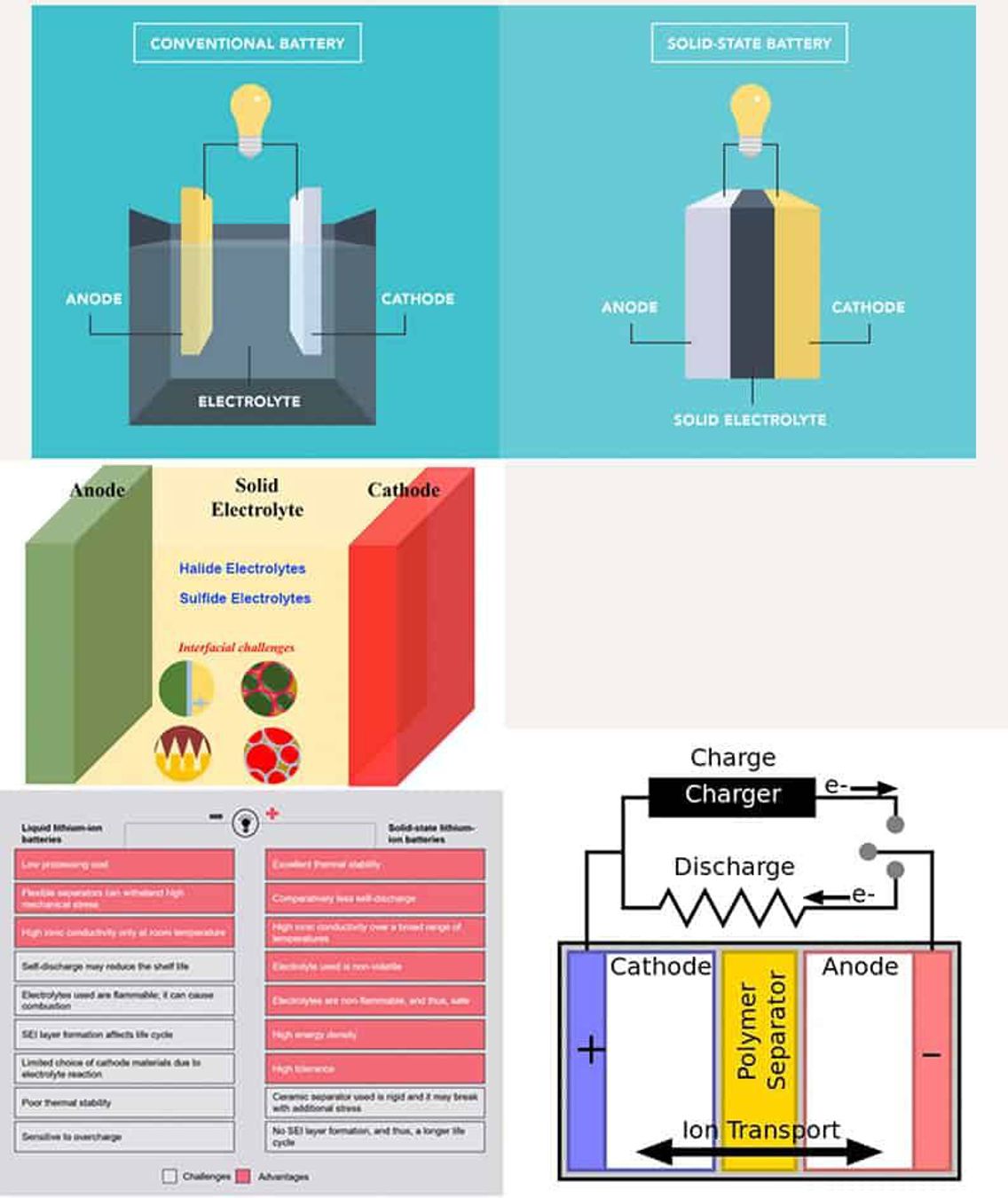
At first glance, a solid-state battery doesn't look that different from a conventional lithium-ion battery. But the heart of the change is precisely in the name: the electrolyte, instead of being a flammable liquid, is a solid material. It can be a polymer, a ceramic oxide, or a vitreous sulfide, but what matters is that this material offers efficient ion conduction, without the dangers associated with liquids.
This innovation makes it possible to eliminate the risk of fire and allows the use of lithium metal anodes, components that pave the way for much lighter, more compact and powerful batteries than current ones.
More energy, more safety, more autonomy
The advantages are many and concrete. Up to 50% higher energy density allows much more energy to be crammed into the same space, or the same energy in a smaller volume. This translates into lighter electric vehicles or with much longer ranges than the current ones.
The solid material is non-flammable, ensuring much greater safety in the event of shocks or overheating. Cyclic life, i.e. the ability to withstand hundreds or thousands of recharges without major decay, reaches levels that are unthinkable today for classic batteries. And that's not all: charging times are drastically shortened. Some experimental prototypes are already able to accumulate energy in a few minutes.
Of course, like all emerging technologies, this one also has its price. Production costs remain high, and the complexity of solid materials requires an industrial supply chain that has yet to consolidate.
The mobility giants really believe in it
Behind the scenes of the great electric transition, companies such as Toyota, QuantumScape, Samsung SDI, BMW and Solid Power are investing billions of dollars to make this promise a reality. Toyota, for example, plans to mount solid-state batteries on some of its models by 2027, with the aim of offering over 1,000 km of range and partial charging in just 10 minutes.
Volkswagen-backed QuantumScape has already achieved remarkable results in laboratory tests, demonstrating batteries capable of maintaining 80% of their capacity after 800 cycles, with very fast charging times. However, there is no shortage of challenges: the interface between the lithium anode and the solid electrolyte is still difficult to stabilize in the long term, and producing these batteries on a large scale requires complex industrial solutions.
Mobility that no longer requires compromises
An electric car that recharges in a few minutes, travels over a thousand kilometers, and is not afraid of shocks or temperature changes. It is a scenario that, until recently, seemed like science fiction. Today, however, it is a goal on the horizon.
But the impact of solid-state batteries could go far beyond the automobile. Aerospace, railway, nautical applications and for grid energy storage are being studied. Lighter, safer, and more durable systems would also be ideal for drones, implantable medical devices, or even space exploration.
The real challenge now is industrial: to build millions of these batteries, reducing costs and ensuring constant performance over time. If we succeed, we will no longer have to choose between performance and sustainability, between autonomy and safety.
Sources and insights
- Rinnovabili.it – Chinese prototype with 300 Wh/kg energy density A concrete update on a solid-state battery made in China and ready for next-generation BEVs. Link
- InsideEVs.it – Solid-state batteries: operation, autonomy and prospects an in-depth study that explains the materials used, the advantages in terms of energy density and recharging, with reference to experimentation in the automotive field. Link
- Vaielettrico.it – Sealence: Italian innovation in solid-state batteries for boatingAn interesting national case: an Italian company that is developing high-density SSB solutions for electric boats. Link
- CORDIS (EU programme) – SOLIDBAT project: European solid-state batteries Information on EU-funded research to develop competitive, sustainable, and viable SSB batteries in Europe. Link
- E-BIKE TRANSFORMATION
- HISTORY OF CIAO PIAGGIO
- EVENTS
- ASSEMBLY OF KITS PURCHASED ONLINE
- OUR AUTHORIZED WORKSHOPS
- MAINTENANCE OF E-BIKES AMBRA ITALIA
- ELECTRIC MICRO-MOBILITY
- SCHOOL PROJECT: INNOVATING WITH AMBRA ITALIA
- ELEGANT AND SUSTAINABLE MOBILITY FOR RECEPTION STRUCTURES
- THE WORLD THROUGH CIAO: OUR CUSTOMERS' STORIES
- RESEARCH AND INNOVATION
- BEHIND THE SCENES OF AMBRA ITALIA
- Differences between Ciao SC and PX series frames and impact on transformation
- The people of Ciao
- Ciao endothermic vs Ciao transformed into an e-bike: analysis of operating costs
- How to read and correctly interpret the Operating Instructions
- Because Ciao is beautiful
- Ciao Piaggio and women: a bond to tell
- Interview with a technician: what is it like to work on an electric Ciao?
- The Silence of the Myth – Pedal-Powered Emotions with an Electric Ciao
- Comparative Analysis of Environmental Impact: Ciao Piaggio Endothermic vs Ciao transformed into an E-Bike
- Safety First: Checking the Safety Systems on Ciao Transformed into E-Bikes
- The Longevity of E-Bikes: How Ambra Italia Extends the Life Cycle of the Ciao Piaggio
- The role of Ciao Piaggio transformed into an e-bike in the challenges of contemporary mobility
- Urban Efficiency: How the Ciao Piaggio transformed into E-Bikes by Ambra Italia revolutionize city spaces with style
- Navigating the Regulations: Current and Future Legislation on Electric Micro Mobility
- Post-Transformation Personalization: Opportunities and Limitations
- Ciao Restoration: Options and Tips
- Comparison between the efficiency of an internal combustion engine and an electric engine in mobility
- Building Long-Lasting Customer Relationships: Strategies for Workshops
- Electric rebirth: the Ciao Piaggio in the era of micro mobility
- Ciao Piaggio in cinema and pop culture
- Electricity System Integration: Challenges and Solutions
- Document Writing Philosophy: Everything Under Control
- Micro-Electric Mobility vs. Long-Distance Electric Mobility: Analysis and Perspectives
- The technology behind the myth: mechanical innovations of the Ciao Piaggio
- Compliance with Regulations: Safety and Certifications
- Steps towards Authorization: How to Become an Authorized Ambra Italia Workshop
- Cleaning and Care of your Ciao transformed into an E-Bike: Tips for Aesthetic Maintenance
- The Operating Instructions and Other Documents for the Assembly and Control of the Processes
- Micro Mobility and Social Responsibility: How Companies Can Make a Difference
- From work to free time: the Ciao Piaggio as a symbol of freedom
- The Materials Used
- From Niche to Mainstream: The Evolution of the Electric Micro Mobility Market
- Joining the Ambra Italia Network: Advantages and Opportunities for New Workshops
- Tests on Critical Components: battery and motor system
- Competing icons
- The Ciao and the urban mobility revolution
- E-Bike or electric motorbike? The choice of the type of transformation determines the approval
- The Role of Electric Micro-Mobility in Reducing Urban Pollution
- Collaborating to Innovate: The Flow of Information between Headquarters and Workshops
- Optimize the battery life of your Ambra Italia e-bike
- Quality Controls on Materials
- Design evolution
- Structural Problems
- Security and Micro Mobility. Standards and Recommended Practices for Electric Driving
- The Emoving Days 2024
- The components of the kit: panoramic
- Excellence in the service: Ambra Italia quality standards
- Basic maintenance of the Ambra Italia-Bike: step by step Guide for Newfits
- Keep the original design
- The future is here
- Birth of an icon