
Visit our page dedicated to the School Institutes project: HERE
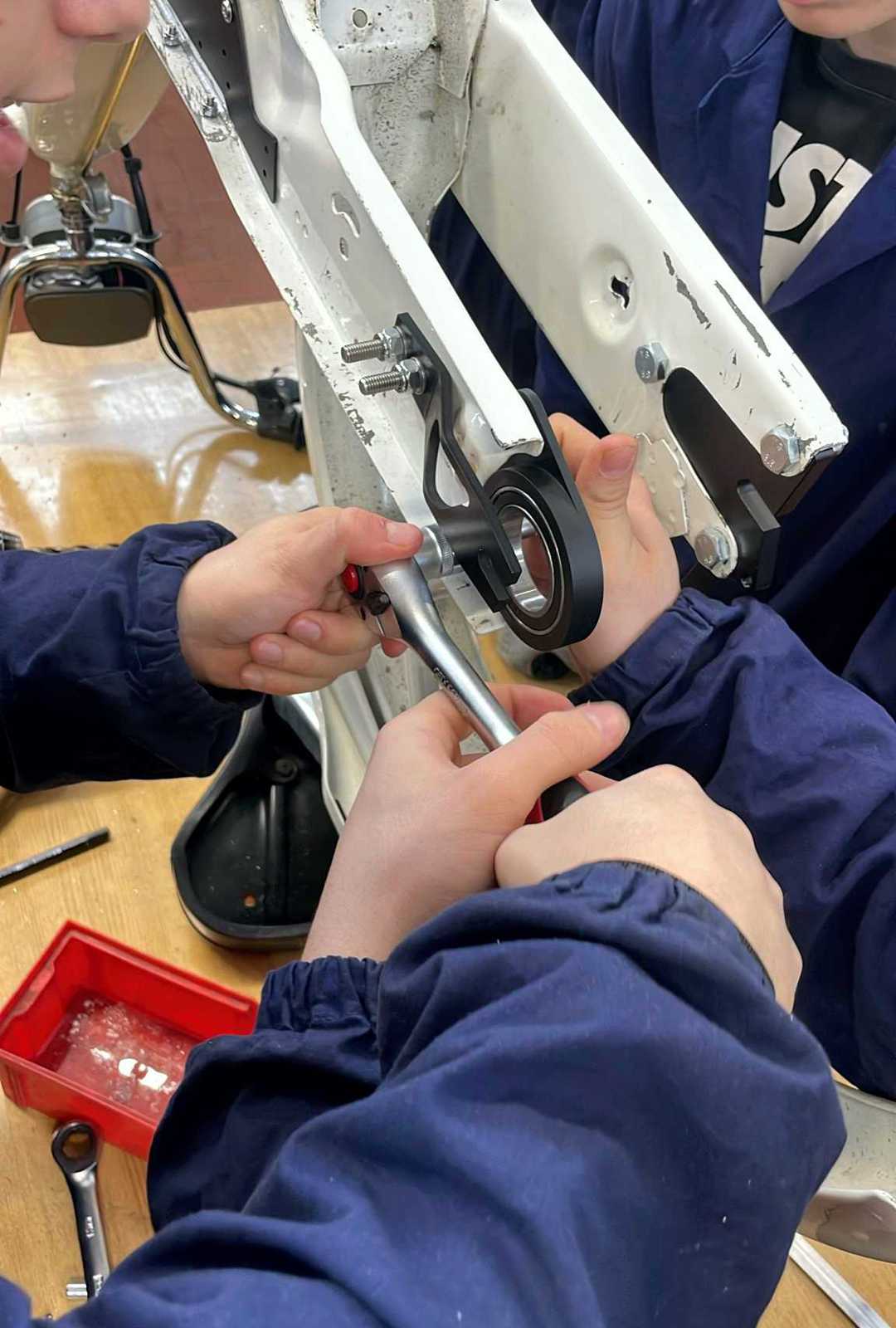
In the heart of an Italy that is looking with growing interest at the ecological transition, two schools are charting a new course in the field of technical and vocational education. At the "G. Galilei" Institute in Milan and at the "Marco Tullio Cicerone" Institute in Sala Consilina (SA), a pilot project that combines tradition and innovation has officially begun: the transformation of the legendary Ciao Piaggio into a modern e-bike, thanks to the collaboration with Ambra Italia, a company specializing in the recovery and electric conversion of historic mopeds.
It is a didactic experimentation with a strong educational value, which aims to bring the central issues of sustainable mobility, technological innovation and applied design into the classroom – and laboratories. Not a simple technical exercise, but a integrated learning path, in which students are confronted with mechanics, electronics, industry regulations and certified quality processes.
"The project – says the headmaster of the IIS Marco Tullio Cicerone in an interview reported by the local press – represents a concrete opportunity to apply the skills learned in the classroom and develop new professionalism in the field of electric mobility"【Source: OndaNews】.
The e-bike as a learning tool and vision of the future
The project is developed around an educational kit provided by Ambra Italia, which allows you to transform a historic moped into a pedal-assisted bicycle that fully complies with European regulations. Each step of the transformation – from the preparation of the chassis to the configuration of the electrical system, passing through safety tests – is accompanied by technical documentation, operating instructions, and training sessions.
The heart of the experience lies not only in manual skills, but in the educational process that is structured around compliance with rules, standards, and the learning of a method. Students are called upon to work in teams, to apply principles of physics and engineering, and to confront real problems to be solved through critical thinking.
School and territory: a laboratory of sustainable mobility
The initiative has also met with great enthusiasm from local communities and local authorities, who see in the project an opportunity to enhance the technical heritage of schools and a concrete contribution to the culture of sustainability.
In the case of the Cicero Institute, the collaboration has already given rise to moments of communication with citizens and the press, while at the Galilei Institute parallel in-depth experiences related to applied electronics and the safety of battery systems are being developed.
The choice to start with an iconic vehicle like the Ciao Piaggio is not accidental. Symbol of an industrial and creative Italy, the Ciao today represents, thanks to this project, a bridge between generations and a living laboratory of accessible technology.
Looking to the future
Ambra Italia plans to extend the initiative to other schools in the coming months, with the aim of building a network of schools that work together on concrete innovation projects. Each participating institute receives not only the technical kit, but also the training support necessary to actively involve teachers and students.
In a context in which technical training often risks being marginalized with respect to the challenges of the future, this initiative shows how central it can be. Accompanying students in the discovery of clean technologies, quality work and the beauty of concrete planning is one of the most effective ways to build a school that is truly in step with the times.
The "Educational Institutes" project, launched at the IIS Galilei in Milan and the IIS Marco Tullio Cicerone in Sala Consilina, has also aroused the interest of the trade press. The Bici.Style portal has dedicated an in-depth analysis to the educational and innovative value of the initiative, highlighting how the transformation of the Ciao Piaggio into an e-bike represents a unique training experience for the students involved.
👉 Read the full article on Bici.Style
- E-BIKE TRANSFORMATION
- HISTORY OF CIAO PIAGGIO
- EVENTS
- ASSEMBLY OF KITS PURCHASED ONLINE
- OUR AUTHORIZED WORKSHOPS
- MAINTENANCE OF E-BIKES AMBRA ITALIA
- ELECTRIC MICRO-MOBILITY
- SCHOOL PROJECT: INNOVATING WITH AMBRA ITALIA
- ELEGANT AND SUSTAINABLE MOBILITY FOR RECEPTION STRUCTURES
- THE WORLD THROUGH CIAO: OUR CUSTOMERS' STORIES
- RESEARCH AND INNOVATION
- BEHIND THE SCENES OF AMBRA ITALIA
- Differences between Ciao SC and PX series frames and impact on transformation
- The people of Ciao
- Ciao endothermic vs Ciao transformed into an e-bike: analysis of operating costs
- How to read and correctly interpret the Operating Instructions
- Because Ciao is beautiful
- Ciao Piaggio and women: a bond to tell
- Interview with a technician: what is it like to work on an electric Ciao?
- The Silence of the Myth – Pedal-Powered Emotions with an Electric Ciao
- Comparative Analysis of Environmental Impact: Ciao Piaggio Endothermic vs Ciao transformed into an E-Bike
- Safety First: Checking the Safety Systems on Ciao Transformed into E-Bikes
- The Longevity of E-Bikes: How Ambra Italia Extends the Life Cycle of the Ciao Piaggio
- The role of Ciao Piaggio transformed into an e-bike in the challenges of contemporary mobility
- Urban Efficiency: How the Ciao Piaggio transformed into E-Bikes by Ambra Italia revolutionize city spaces with style
- Navigating the Regulations: Current and Future Legislation on Electric Micro Mobility
- Post-Transformation Personalization: Opportunities and Limitations
- Ciao Restoration: Options and Tips
- Comparison between the efficiency of an internal combustion engine and an electric engine in mobility
- Building Long-Lasting Customer Relationships: Strategies for Workshops
- Electric rebirth: the Ciao Piaggio in the era of micro mobility
- Ciao Piaggio in cinema and pop culture
- Electricity System Integration: Challenges and Solutions
- Document Writing Philosophy: Everything Under Control
- Micro-Electric Mobility vs. Long-Distance Electric Mobility: Analysis and Perspectives
- The technology behind the myth: mechanical innovations of the Ciao Piaggio
- Compliance with Regulations: Safety and Certifications
- Steps towards Authorization: How to Become an Authorized Ambra Italia Workshop
- Cleaning and Care of your Ciao transformed into an E-Bike: Tips for Aesthetic Maintenance
- The Operating Instructions and Other Documents for the Assembly and Control of the Processes
- Micro Mobility and Social Responsibility: How Companies Can Make a Difference
- From work to free time: the Ciao Piaggio as a symbol of freedom
- The Materials Used
- From Niche to Mainstream: The Evolution of the Electric Micro Mobility Market
- Joining the Ambra Italia Network: Advantages and Opportunities for New Workshops
- Tests on Critical Components: battery and motor system
- Competing icons
- The Ciao and the urban mobility revolution
- E-Bike or electric motorbike? The choice of the type of transformation determines the approval
- The Role of Electric Micro-Mobility in Reducing Urban Pollution
- Collaborating to Innovate: The Flow of Information between Headquarters and Workshops
- Optimize the battery life of your Ambra Italia e-bike
- Quality Controls on Materials
- Design evolution
- Structural Problems
- Security and Micro Mobility. Standards and Recommended Practices for Electric Driving
- The Emoving Days 2024
- The components of the kit: panoramic
- Excellence in the service: Ambra Italia quality standards
- Basic maintenance of the Ambra Italia-Bike: step by step Guide for Newfits
- Keep the original design
- The future is here
- Birth of an icon