
Visit our page dedicated to the Schools project: QUI
This interview is part of the column dedicated to the "Schools Project: Innovating with Ambra Italia", which tells the concrete experiences of the Italian Technical Institutes involved in the transformation of the Ciao Piaggio into an e-bike. An initiative created to combine education, sustainability, and advanced craftsmanship, bringing electric mobility directly into the classroom and laboratory.
The Ambra Italia project between technique, passion, and inclusion
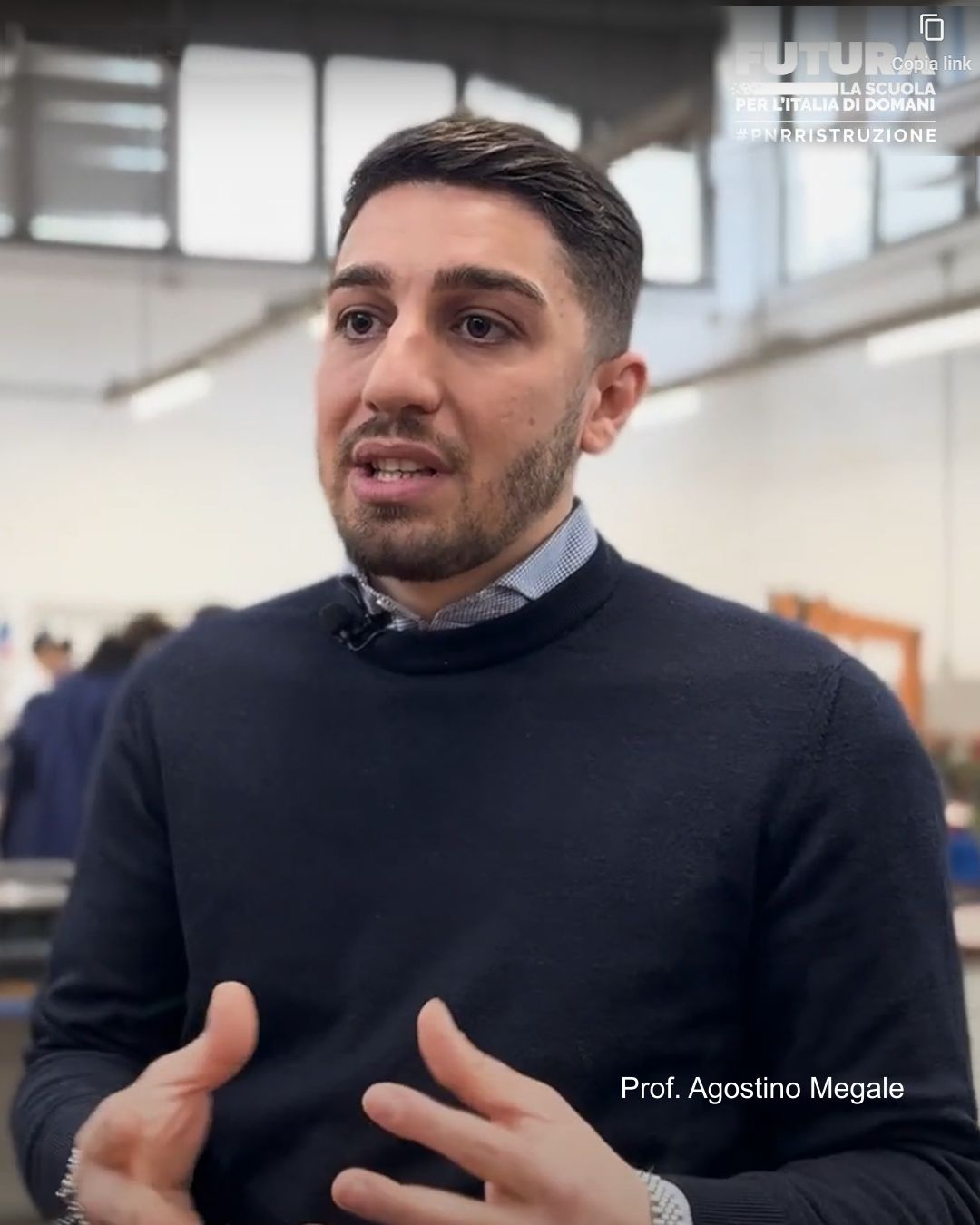
Inside the IIS Galilei Luxemburg in Milan, one of the technical institutes that has enthusiastically joined the Ambra Italia project for schools, we have collected the testimony of Prof. Agostino Megale. Professor of Mechanics and Mechatronics and head of the PCTO courses, Professor Megale guided his students in a unique training experience: transforming a historic Piaggio Ciao into a modern e-bike. In this interview he tells us how it went, between commitment, passion, and active participation of the students.
Professor, can you briefly tell us who you are and what your role is within the institute?
Sure. I am Agostino Megale, and I teach the Mechanics and Mechatronics laboratory at the IIS Galilei Luxemburg in Milan. For five years I have also been involved in the school-work alternation project (PCTO), an experience that I consider fundamental because it allows students to confront themselves with the real world of companies and technologies. My goal is clear: to transform theory into practice, offering students concrete opportunities to discover how much what they learn in the classroom can really become a skill that can be used in work and life.
How did you find out about the Ambra Italia project? What prompted you to join?
The project was presented to us by the headmistress during a meeting of the mechanical department. Together with my colleague Giuseppe De Luca we immediately grasped the value of this initiative. The idea of taking a historic vehicle like the Piaggio Ciao and transforming it into an electric vehicle is not only fascinating: it is a bridge between tradition and innovation. It convinced us because it represents a unique opportunity to integrate teaching, sustainability, and passion for technology. In this way, the students do not limit themselves to studying the ecological transition, but experience it with their own hands, experiencing firsthand the transformation of mobility towards a more sustainable future.
The classroom experience
How did the students react when the project was presented?
With great enthusiasm! It does not happen often to be able to "get your hands" on something so concrete and at the same time linked to the history of our country. Especially for us who are in a difficult neighborhood like San Siro, this project has had an added value: many young people have also involved their families, telling the project at home, and this has created a nice sense of community.
How did you organize the work in class? What were the main phases of the transformation of Ciao?
We started with a study phase: technical analysis of the vehicle, understanding of the original operation and design of the electrical transformation. Then we moved on to disassembly, integration of the electrical kit and finally road tests. All this was accompanied by precise and timely technical documentation.
What technical and practical skills have you seen develop most in the children?
In addition to mechanical and electronic skills, I noticed an improvement in the ability to work in a team, to solve practical problems and to respect times and roles. The ability to document work professionally has also grown a lot: an aspect that is often underestimated, but fundamental in the world of work.
Educational and human aspects
Was there a particular moment, during the project, that struck or excited you?
Yes, when you first turn on your electric Ciao. Seeing the students' eyes shine with the result obtained with their own hands was really exciting. It's one of those moments that remind us of because we teach.
Have you noticed changes in students in terms of involvement, motivation, or sense of responsibility?
Yes. Some students who struggled in the classroom proved to be fundamental in the laboratory, showing surprising practical skills. This has also improved the self-esteem of many and strengthened the class group.
In your opinion, how much influence can working on a "historical" object like the Ciao influence to stimulate the interest of young people?
Very much. the Ciao has a symbolic value, it recalls family memories, stories of parents. This emotional and cultural bond makes the project even more engaging for the children.
Assessment and reflections
Overall, are you satisfied with the final result? Is there anything you would do differently?
I am very satisfied. If I had to do it again, I would spend more time in the initial planning phase, to avoid some difficulties encountered during assembly. But every mistake was also an opportunity for learning.
Do you believe that this type of experience can also be replicated in other school or training contexts?
Undoubtedly. It is a project that can adapt to various technical and professional addresses, even with different levels of complexity. In addition, it offers a wonderful opportunity for collaboration between school, territory, and companies.
What message would you like to leave to colleagues and school principals who are considering the possibility of participating in the Ambra Italia project?
Have no doubt: it is an experience that enriches not only the students, but also us teachers. The Ambra Italia project is a concrete example of a school that trains, inspires and connects past, present and future.
Finally, I would like to thank Mr. Tiberio Casali, owner of Ambra Italia, and Headmistress Annamaria Borando for their support and patience throughout this journey.
- E-BIKE TRANSFORMATION
- HISTORY OF CIAO PIAGGIO
- EVENTS
- ASSEMBLY OF KITS PURCHASED ONLINE
- OUR AUTHORIZED WORKSHOPS
- MAINTENANCE OF E-BIKES AMBRA ITALIA
- ELECTRIC MICRO-MOBILITY
- SCHOOL PROJECT: INNOVATING WITH AMBRA ITALIA
- ELEGANT AND SUSTAINABLE MOBILITY FOR RECEPTION STRUCTURES
- THE WORLD THROUGH CIAO: OUR CUSTOMERS' STORIES
- RESEARCH AND INNOVATION
- BEHIND THE SCENES OF AMBRA ITALIA
- Differences between Ciao SC and PX series frames and impact on transformation
- The people of Ciao
- Ciao endothermic vs Ciao transformed into an e-bike: analysis of operating costs
- How to read and correctly interpret the Operating Instructions
- Because Ciao is beautiful
- Ciao Piaggio and women: a bond to tell
- Interview with a technician: what is it like to work on an electric Ciao?
- The Silence of the Myth – Pedal-Powered Emotions with an Electric Ciao
- Comparative Analysis of Environmental Impact: Ciao Piaggio Endothermic vs Ciao transformed into an E-Bike
- Safety First: Checking the Safety Systems on Ciao Transformed into E-Bikes
- The Longevity of E-Bikes: How Ambra Italia Extends the Life Cycle of the Ciao Piaggio
- The role of Ciao Piaggio transformed into an e-bike in the challenges of contemporary mobility
- Urban Efficiency: How the Ciao Piaggio transformed into E-Bikes by Ambra Italia revolutionize city spaces with style
- Navigating the Regulations: Current and Future Legislation on Electric Micro Mobility
- Post-Transformation Personalization: Opportunities and Limitations
- Ciao Restoration: Options and Tips
- Comparison between the efficiency of an internal combustion engine and an electric engine in mobility
- Building Long-Lasting Customer Relationships: Strategies for Workshops
- Electric rebirth: the Ciao Piaggio in the era of micro mobility
- Ciao Piaggio in cinema and pop culture
- Electricity System Integration: Challenges and Solutions
- Document Writing Philosophy: Everything Under Control
- Micro-Electric Mobility vs. Long-Distance Electric Mobility: Analysis and Perspectives
- The technology behind the myth: mechanical innovations of the Ciao Piaggio
- Compliance with Regulations: Safety and Certifications
- Steps towards Authorization: How to Become an Authorized Ambra Italia Workshop
- Cleaning and Care of your Ciao transformed into an E-Bike: Tips for Aesthetic Maintenance
- The Operating Instructions and Other Documents for the Assembly and Control of the Processes
- Micro Mobility and Social Responsibility: How Companies Can Make a Difference
- From work to free time: the Ciao Piaggio as a symbol of freedom
- The Materials Used
- From Niche to Mainstream: The Evolution of the Electric Micro Mobility Market
- Joining the Ambra Italia Network: Advantages and Opportunities for New Workshops
- Tests on Critical Components: battery and motor system
- Competing icons
- The Ciao and the urban mobility revolution
- E-Bike or electric motorbike? The choice of the type of transformation determines the approval
- The Role of Electric Micro-Mobility in Reducing Urban Pollution
- Collaborating to Innovate: The Flow of Information between Headquarters and Workshops
- Optimize the battery life of your Ambra Italia e-bike
- Quality Controls on Materials
- Design evolution
- Structural Problems
- Security and Micro Mobility. Standards and Recommended Practices for Electric Driving
- The Emoving Days 2024
- The components of the kit: panoramic
- Excellence in the service: Ambra Italia quality standards
- Basic maintenance of the Ambra Italia-Bike: step by step Guide for Newfits
- Keep the original design
- The future is here
- Birth of an icon