
A material lighter than paper, stronger than steel and able to conduct electricity better than copper. It sounds like science fiction, yet it is reality. Its name is graphene, and it is only the tip of the iceberg of a new generation of materials: two-dimensional materials.
Discovered in 2004 by Andre Geim and Konstantin Novoselov – a discovery that earned them the Nobel Prize in Physics in 2010 – graphene is composed of a single layer of carbon atoms arranged in a honeycomb structure. Since then, interest in this material has exploded. Universities, companies, governments: everyone is trying to understand it, manipulate it, tame it. Because? Because graphene promises to revolutionize the way we store, transport, and use energy.
A battery unlike any other
In the world of electric mobility, one of the biggest challenges is range. Traditional batteries – especially lithium-ion batteries – are now close to their theoretical limits in terms of energy density, weight, and durability. This is where graphene comes into play.
Imagine an e-bike that recharges in a few minutes and can travel tens of kilometers without loss of performance. A battery that lasts thousands of cycles without losing efficiency. Graphene can make this possible. Thanks to its ultra-large surface area, extraordinary electronic conduction and structural flexibility, graphene can be used to build ultra-thin electrodes, high-performance supercapacitors and even hybrid batteries that can combine power and durability in a single device.
But it's not just a question of efficiency. Graphene batteries, in advanced tests, are also safer: they produce less heat and are less prone to chemical instability.
Beyond energy: a world to be rewritten
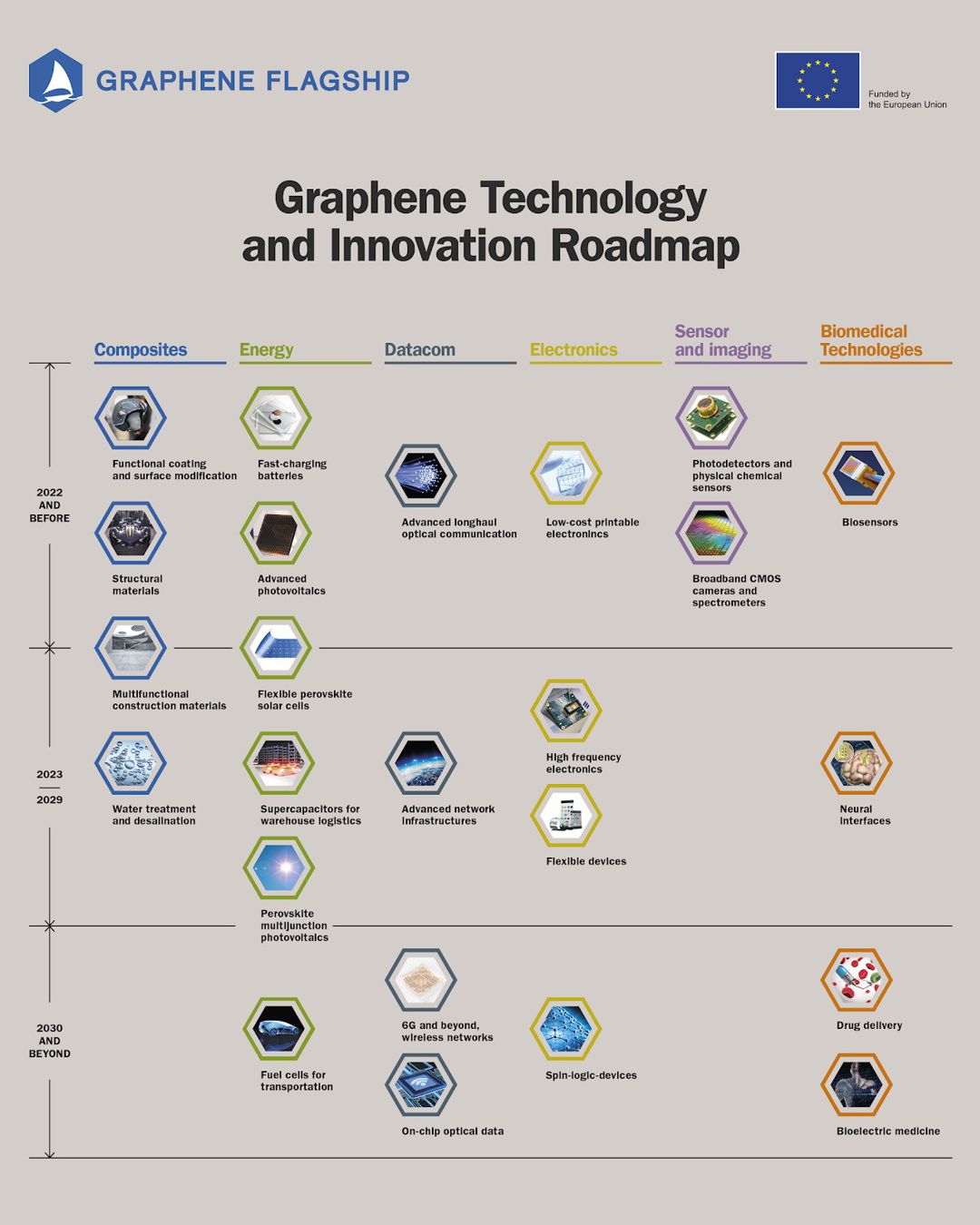
But it would be reductive to think of graphene only as a "battery material". This two-dimensional marvel is at the heart of a transformation that involves many other sectors:
- In electronics, graphene transistors capable of operating at frequencies unthinkable for silicon are studied. The dream? Computers millions of times faster and power consumption reduced to the bone.
- In medicine, graphene is used for ultra-sensitive sensors, flexible prostheses, biocompatible materials.
- In construction, graphene-reinforced cements are being experimented with, capable of lasting longer and better resisting stress.
- And even in the aerospace sector, graphene could pave the way for lighter and stronger hulls for spacecraft and drones.
Not only that: new families of similar materials – such as transition metal dichalcogenides (e.g. MoS₂), MXene, phosphorenes – are extending the potential of the so-called "2D matter", offering specialized solutions for every need: thermal insulation, superconductivity, chemical resistance, data storage.
A present that is still young, but a future already written
Of course, the road is not without obstacles. Graphene is still difficult to produce on a large scale in a cost-effective and uniform way. Some of its extraordinary properties, observed in the laboratory, are reduced when the material is integrated into real devices. Yet, research is making great strides: new synthesis processes, such as CVD (Chemical Vapor Deposition), and new design models are making graphene more accessible, more "domestic".
Many analysts believe that the next ten years will be decisive: by 2035, graphene could be everywhere. Inside our cars, our smartphones, our homes.
Graphene is more than a material. It is a technological threshold, a symbol of the new era of innovation. Just as silicon has been at the heart of the digital revolution, graphene and its 2D siblings could be the protagonists of the energy revolution.
And if today we study them with amazement, tomorrow we will take them for granted. Just as happened with electricity, the microchip, or the internet.
Sources and Insights
- Graphene: properties and challenges of the material of the future. A detailed article on the properties, applications and limitations of graphene in the energy sector.
Read about Digital Agenda - Graphene in the future of photovoltaic energy. Report on a workshop dedicated to the role of graphene in renewable energy and storage. Discover Enel Green Power
- The Graphene project lands in Genoa. Description of an Italian project related to the production of two-dimensional materials with repercussions in the energy field. Read on the website of the Italian Institute of Technology
- The solar park shines thanks to the two-dimensional materials. Real case of application of 2D materials (graphene and perovskite) in photovoltaic panels in Crete, with Italian contribution. Read on Le Scienze
- From graphene new ways for the efficient separation of gases. CNR study showing how graphene can improve gas filters and separation processes. Read on the CNR website
- E-BIKE TRANSFORMATION
- HISTORY OF CIAO PIAGGIO
- EVENTS
- ASSEMBLY OF KITS PURCHASED ONLINE
- OUR AUTHORIZED WORKSHOPS
- MAINTENANCE OF E-BIKES AMBRA ITALIA
- ELECTRIC MICRO-MOBILITY
- SCHOOL PROJECT: INNOVATING WITH AMBRA ITALIA
- ELEGANT AND SUSTAINABLE MOBILITY FOR RECEPTION STRUCTURES
- THE WORLD THROUGH CIAO: OUR CUSTOMERS' STORIES
- RESEARCH AND INNOVATION
- BEHIND THE SCENES OF AMBRA ITALIA
- Differences between Ciao SC and PX series frames and impact on transformation
- The people of Ciao
- Ciao endothermic vs Ciao transformed into an e-bike: analysis of operating costs
- How to read and correctly interpret the Operating Instructions
- Because Ciao is beautiful
- Ciao Piaggio and women: a bond to tell
- Interview with a technician: what is it like to work on an electric Ciao?
- The Silence of the Myth – Pedal-Powered Emotions with an Electric Ciao
- Comparative Analysis of Environmental Impact: Ciao Piaggio Endothermic vs Ciao transformed into an E-Bike
- Safety First: Checking the Safety Systems on Ciao Transformed into E-Bikes
- The Longevity of E-Bikes: How Ambra Italia Extends the Life Cycle of the Ciao Piaggio
- The role of Ciao Piaggio transformed into an e-bike in the challenges of contemporary mobility
- Urban Efficiency: How the Ciao Piaggio transformed into E-Bikes by Ambra Italia revolutionize city spaces with style
- Navigating the Regulations: Current and Future Legislation on Electric Micro Mobility
- Post-Transformation Personalization: Opportunities and Limitations
- Ciao Restoration: Options and Tips
- Comparison between the efficiency of an internal combustion engine and an electric engine in mobility
- Building Long-Lasting Customer Relationships: Strategies for Workshops
- Electric rebirth: the Ciao Piaggio in the era of micro mobility
- Ciao Piaggio in cinema and pop culture
- Electricity System Integration: Challenges and Solutions
- Document Writing Philosophy: Everything Under Control
- Micro-Electric Mobility vs. Long-Distance Electric Mobility: Analysis and Perspectives
- The technology behind the myth: mechanical innovations of the Ciao Piaggio
- Compliance with Regulations: Safety and Certifications
- Steps towards Authorization: How to Become an Authorized Ambra Italia Workshop
- Cleaning and Care of your Ciao transformed into an E-Bike: Tips for Aesthetic Maintenance
- The Operating Instructions and Other Documents for the Assembly and Control of the Processes
- Micro Mobility and Social Responsibility: How Companies Can Make a Difference
- From work to free time: the Ciao Piaggio as a symbol of freedom
- The Materials Used
- From Niche to Mainstream: The Evolution of the Electric Micro Mobility Market
- Joining the Ambra Italia Network: Advantages and Opportunities for New Workshops
- Tests on Critical Components: battery and motor system
- Competing icons
- The Ciao and the urban mobility revolution
- E-Bike or electric motorbike? The choice of the type of transformation determines the approval
- The Role of Electric Micro-Mobility in Reducing Urban Pollution
- Collaborating to Innovate: The Flow of Information between Headquarters and Workshops
- Optimize the battery life of your Ambra Italia e-bike
- Quality Controls on Materials
- Design evolution
- Structural Problems
- Security and Micro Mobility. Standards and Recommended Practices for Electric Driving
- The Emoving Days 2024
- The components of the kit: panoramic
- Excellence in the service: Ambra Italia quality standards
- Basic maintenance of the Ambra Italia-Bike: step by step Guide for Newfits
- Keep the original design
- The future is here
- Birth of an icon