
A world in which every means of transport – from cars to trains, from trucks to planes – moves without emitting a single particle of CO₂. A world where water is the raw material of a silent revolution, and what comes out of the exhaust pipe is only steam. This is the dream that has accompanied the vision of hydrogen as the energy carrier of the future for decades. But today, with the increasingly urgent pressure of the ecological transition, that dream is back with a new guise: green hydrogen, produced with renewable energy. Next to him, fuel cells – the so-called fuel cells – which promise to transform that hydrogen into clean electricity. But the question remains: is this vision a real alternative or just a fascinating illusion?
The heart of the technology: how green hydrogen works
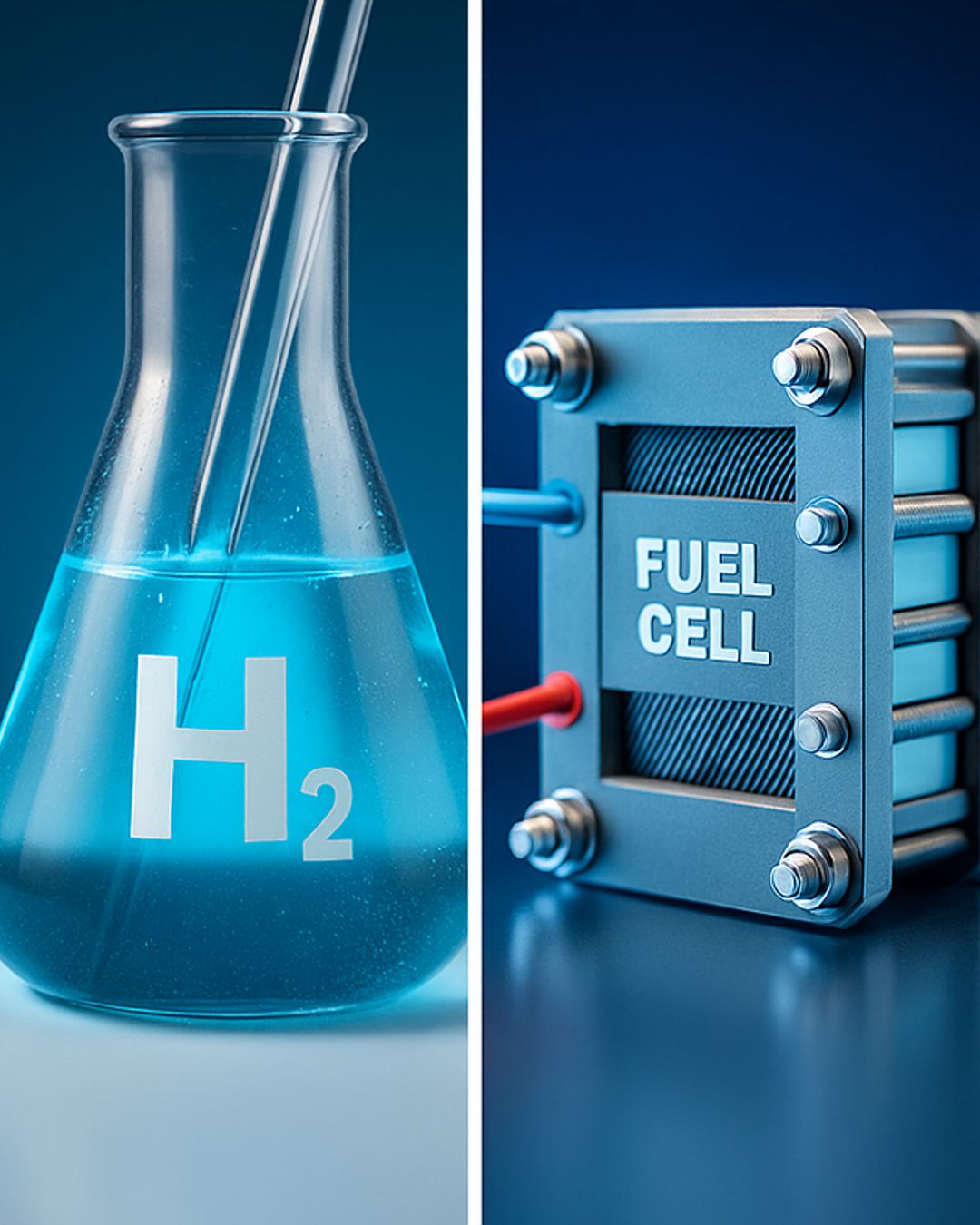
Green hydrogen is produced through a process called water electrolysis, which consists of splitting H₂O molecules into hydrogen (H₂) and oxygen (O₂) using electricity from renewable sources (such as solar, wind, or hydroelectric). This technique does not generate greenhouse gas emissions during production, making green hydrogen one of the most promising solutions for a zero-emission energy transition.
To better understand the environmental value of this technology, it is useful to distinguish between the various types of hydrogen, classified according to the production method:
- Grey hydrogen is currently the most widespread globally. It is obtained through steam reforming of methane (natural gas), an inexpensive, but highly polluting process, which involves the direct emission of large quantities of CO₂ into the atmosphere. It is therefore the least sustainable form.
- Blue hydrogen, which is more recent, derives from the same process as gray but is flanked by CO₂ capture and storage (CCS) technologies. This improves its environmental profile, but still ties it to fossil fuels and technologically advanced and expensive infrastructure.
- Green hydrogen, on the other hand, is considered the ideal "point of arrival". It does not involve climate-changing emissions, as long as the electricity used for electrolysis also comes entirely from renewable sources. At the moment, production costs are still high compared to alternatives, but technological progress and falling prices of renewables could make this option increasingly competitive.
Thanks to its versatility, green hydrogen can be used to power fuel cells, store energy from intermittent sources, decarbonize hard-to-electrify sectors such as heavy industry, aviation, and long-distance transport. However, to make this vision a reality, clear public policies, incentives, dedicated infrastructure, and a strong commitment to research will be needed.
Benefits that look like something out of a science fiction movie
The first advantage is visible to the naked eye: zero emissions during use. It is no coincidence that many major car manufacturers speak of "hydrogen vehicles" as true zero-impact mobility.
The second is in the refueling times: a few minutes for a full tank, just as is the case today with petrol or diesel. The third concerns heavy vehicles: for long-haul transport – trucks, trains, ships, planes – hydrogen offers a longer range with low weight, where electric batteries still struggle. Finally, there's flexibility: hydrogen can be produced anywhere there is water and sun or wind, offering energy independence and a smart way to store excess renewable energy.
But there is a price to pay
Like all emerging technologies, green hydrogen also has its critical nodes. The most obvious? The cost: producing hydrogen with electrolysis is still much more expensive than traditional methods. Then there is efficiency: between production, compression, transport, and conversion into electricity, up to 70% of the initial energy is lost. A sobering figure, especially when compared to the efficiency of batteries. The infrastructural problem should not be forgotten: there are very few hydrogen distributors, the logistics networks almost non-existent. And finally, the safety factor: hydrogen is flammable, light, difficult to manage – even if containment technologies are making great strides.
Between hydrogen trains and futuristic trucks: the first experiments are real
Hydrogen is not just theory. In Germany, the Coradia iLint hydrogen train is already a reality. In Italy, tests are being conducted to introduce similar trains on some regional routes. Urban transport companies, such as Toyota, Hyundai or the American startup Nikola, are developing fuel cell trucks and buses. Airbus even aims to fly a hydrogen aircraft by 2035. And in some European steel mills, hydrogen is already being used to reduce the use of coal, making heavy industry cleaner. The way is open. But not yet paved.
The truth lies in the middle
Green hydrogen is not a universal panacea, but neither is it an illusion. For private cars, battery electric is now more efficient, more accessible and with more developed infrastructure. But for trucks, trains, planes, industries, and long-term energy storage, hydrogen can make all the difference. Its credibility will depend on its ability to reduce costs, boost renewable production, and create a robust industrial and logistics supply chain. After all, every revolution needs time, vision and investment.
Sources and insights
- E-BIKE TRANSFORMATION
- HISTORY OF CIAO PIAGGIO
- EVENTS
- ASSEMBLY OF KITS PURCHASED ONLINE
- OUR AUTHORIZED WORKSHOPS
- MAINTENANCE OF E-BIKES AMBRA ITALIA
- ELECTRIC MICRO-MOBILITY
- SCHOOL PROJECT: INNOVATING WITH AMBRA ITALIA
- ELEGANT AND SUSTAINABLE MOBILITY FOR RECEPTION STRUCTURES
- THE WORLD THROUGH CIAO: OUR CUSTOMERS' STORIES
- RESEARCH AND INNOVATION
- BEHIND THE SCENES OF AMBRA ITALIA
- Differences between Ciao SC and PX series frames and impact on transformation
- The people of Ciao
- Ciao endothermic vs Ciao transformed into an e-bike: analysis of operating costs
- How to read and correctly interpret the Operating Instructions
- Because Ciao is beautiful
- Ciao Piaggio and women: a bond to tell
- Interview with a technician: what is it like to work on an electric Ciao?
- The Silence of the Myth – Pedal-Powered Emotions with an Electric Ciao
- Comparative Analysis of Environmental Impact: Ciao Piaggio Endothermic vs Ciao transformed into an E-Bike
- Safety First: Checking the Safety Systems on Ciao Transformed into E-Bikes
- The Longevity of E-Bikes: How Ambra Italia Extends the Life Cycle of the Ciao Piaggio
- The role of Ciao Piaggio transformed into an e-bike in the challenges of contemporary mobility
- Urban Efficiency: How the Ciao Piaggio transformed into E-Bikes by Ambra Italia revolutionize city spaces with style
- Navigating the Regulations: Current and Future Legislation on Electric Micro Mobility
- Post-Transformation Personalization: Opportunities and Limitations
- Ciao Restoration: Options and Tips
- Comparison between the efficiency of an internal combustion engine and an electric engine in mobility
- Building Long-Lasting Customer Relationships: Strategies for Workshops
- Electric rebirth: the Ciao Piaggio in the era of micro mobility
- Ciao Piaggio in cinema and pop culture
- Electricity System Integration: Challenges and Solutions
- Document Writing Philosophy: Everything Under Control
- Micro-Electric Mobility vs. Long-Distance Electric Mobility: Analysis and Perspectives
- The technology behind the myth: mechanical innovations of the Ciao Piaggio
- Compliance with Regulations: Safety and Certifications
- Steps towards Authorization: How to Become an Authorized Ambra Italia Workshop
- Cleaning and Care of your Ciao transformed into an E-Bike: Tips for Aesthetic Maintenance
- The Operating Instructions and Other Documents for the Assembly and Control of the Processes
- Micro Mobility and Social Responsibility: How Companies Can Make a Difference
- From work to free time: the Ciao Piaggio as a symbol of freedom
- The Materials Used
- From Niche to Mainstream: The Evolution of the Electric Micro Mobility Market
- Joining the Ambra Italia Network: Advantages and Opportunities for New Workshops
- Tests on Critical Components: battery and motor system
- Competing icons
- The Ciao and the urban mobility revolution
- E-Bike or electric motorbike? The choice of the type of transformation determines the approval
- The Role of Electric Micro-Mobility in Reducing Urban Pollution
- Collaborating to Innovate: The Flow of Information between Headquarters and Workshops
- Optimize the battery life of your Ambra Italia e-bike
- Quality Controls on Materials
- Design evolution
- Structural Problems
- Security and Micro Mobility. Standards and Recommended Practices for Electric Driving
- The Emoving Days 2024
- The components of the kit: panoramic
- Excellence in the service: Ambra Italia quality standards
- Basic maintenance of the Ambra Italia-Bike: step by step Guide for Newfits
- Keep the original design
- The future is here
- Birth of an icon